I have to share this amazing visual illusion with you.
Sean Murphy, an honours student in our lab, was playing around with some faces for an experiment. He aligned the faces at the eyes and then started flicking through them. He was shocked by the ugly faces staring back at him.
We called it the Flashed Face Distortion Effect. But we don’t yet know what causes it.
The effect might have something to do with relative encoding. That is, forcing people to encode each face in light of the others. By eye-aligning the faces, it becomes much easier to compare their shape and the relative location of their features, so the differences between them become more evident. And it’s most certainly related to work on adaptation, and the face distortion after effect specifically.
You can read more about it here and request a copy of the paper here. I hope you find the effect as jaw-dropping as I do!
Matt
mbthompson.com
Tangen, J. M., Murphy, S., & Thompson, M. B. (2011). Flashed face distortion effect: Grotesque faces from relative spaces. Perception advance online publication, doi:10.1068/p6968

Friday, July 8, 2011

Tuesday, June 28, 2011
Taking responsibility for your professional development
“The price of greatness is responsibility”
- Winston Churchill
As PhD students our primary focus often tends to be on final products and bottom lines. We ruminate about what the thesis will be like, how to get more publications, and other external indicators of quality. In this pursuit of end goals, it can be easy to lose sight of other important factors in our education, like professional development. By professional development I mean things that don’t necessarily contribute to the final product of the thesis or a particular publication, but that contribute overall to making us better researchers. Like the famous quote goes: it’s the journey, not the destination that’s important.
There are many ways to develop as a researcher. It may involve learning new statistical or methodological skills, or attending workshops, conferences and summer schools (which I’ve posted about previously). Whatever the form of professional development, I believe the key is that students take responsibility for their own development trajectory. While a lucky few people may benefit from a supervisor who goes out of their way to mentor, guide, and shape them as a member of the research community, not everyone can expect such treatment. Ultimately, it’s up to each of us individually to take advantage of development opportunities where they exist and create them for ourselves where they don’t.
At UQ we’re very lucky to have an environment that supports professional development. Weekly seminars for RHD (Research Higher Degree) students are run on topics as varied as advancing statistical know-how to time management and achieving work-life balance. We also have an annual RHD day that celebrates the research of postgraduate students and offers an opportunity to present in front of a friendly audience.
But there are also countless opportunities for professional development outside your research institution. Attendance at conferences is an absolute must. Not only do you get great ideas from hearing others talk, there are often round-table discussions or pre-conferences dedicated to key professional development topics. Consider travel in and of itself as a professional development opportunity. There is something about seeing the processes of different labs that broadens your research perspective. Not to mention the opportunity to discuss your research with people who know nothing about it.
Oftentimes professional development requires stepping outside your comfort zone. It involves putting yourself in a position of admitting that you don’t know everything. Developing often means talking to and asking advice from people who scare you a little. Don’t forget that the benefits of professional development – that make you a better, more connected and impactful researcher – will ultimately far outweigh the temporary discomfort of putting yourself out there. The key thing to remember is that only you are truly responsible for your professional development. It’s through this responsibility that we can each achieve our own modest form of greatness.
Thursday, June 16, 2011
Healthy Skepticism
In my last post I told you about some of my research on crime-scene fingerprint identification. Turns out that it’s actually a human, not a computer, who decides whether a crime-scene print matches a suspect or not. To make a decision, examiners place prints side-by-side, visually inspect them, and declare that the prints match or not, based on their training and experience.

The problem is that, even though fingerprints have been used in criminal courts for more than 100 years, no properly controlled experiments on fingerprint examiners' accuracy in identifying perpetrators had been conducted. Some experts have even claimed to be infallible, but mistakes made to date have resulted in innocent people being wrongly accused.
We wanted to find out whether these experts were any more accurate than the average person, and to get an idea of how many criminals are being wrongly set free and how many innocents are being wrongly convicted. Well, it took two years of planning and a visit to every major state police department in Australia, but we finally managed to conduct the critical experiment.
We gave 37 qualified fingerprint experts and 37 UQ students pairs of fingerprints to examine and decide whether a simulated crime-scene print matched a potential suspect or not. Some of the print pairs belonged to the "criminal" while others were highly similar but actually belonged to an "innocent" person.
The experts correctly matched just over 92 percent of the prints to the criminal. But, they mistakenly matched 0.68 percent of the prints to the innocent person. That they made so few errors means pretty impressive human performance, in my opinion.
We concluded that qualified court-practicing fingerprint experts are exceedingly accurate compared to novices, but are not infallible. Our experts tended to err on the side of caution by making errors that would free the guilty rather than convict the innocent. Even so, they made the kind of error that may lead to false convictions.
So, was my initial skepticism unwarranted?
Well, I think healthy skepticism is the cornerstone of science and rational enquiry. Fingerprint examiners make important decisions that can put lives and livelihoods at risk and the burden of proof is on the profession to demonstrate the scientific validity and reliability of its claims. We’ve worked closely with examiners, who were were eager to demonstrate their abilities, and we’ve shown that expertise with prints provides a real benefit.
Even though this one experiment consumed my existence for two years, it was totally worth it!
Matt
mbthompson.com
Tangen, J. M., Thompson, M. B., & McCarthy D. J. (2011). Identifying Fingerprint Expertise. Psychological Science. [PDF] [Press Release]

The problem is that, even though fingerprints have been used in criminal courts for more than 100 years, no properly controlled experiments on fingerprint examiners' accuracy in identifying perpetrators had been conducted. Some experts have even claimed to be infallible, but mistakes made to date have resulted in innocent people being wrongly accused.
We wanted to find out whether these experts were any more accurate than the average person, and to get an idea of how many criminals are being wrongly set free and how many innocents are being wrongly convicted. Well, it took two years of planning and a visit to every major state police department in Australia, but we finally managed to conduct the critical experiment.
We gave 37 qualified fingerprint experts and 37 UQ students pairs of fingerprints to examine and decide whether a simulated crime-scene print matched a potential suspect or not. Some of the print pairs belonged to the "criminal" while others were highly similar but actually belonged to an "innocent" person.
The experts correctly matched just over 92 percent of the prints to the criminal. But, they mistakenly matched 0.68 percent of the prints to the innocent person. That they made so few errors means pretty impressive human performance, in my opinion.
We concluded that qualified court-practicing fingerprint experts are exceedingly accurate compared to novices, but are not infallible. Our experts tended to err on the side of caution by making errors that would free the guilty rather than convict the innocent. Even so, they made the kind of error that may lead to false convictions.
So, was my initial skepticism unwarranted?
Well, I think healthy skepticism is the cornerstone of science and rational enquiry. Fingerprint examiners make important decisions that can put lives and livelihoods at risk and the burden of proof is on the profession to demonstrate the scientific validity and reliability of its claims. We’ve worked closely with examiners, who were were eager to demonstrate their abilities, and we’ve shown that expertise with prints provides a real benefit.
Even though this one experiment consumed my existence for two years, it was totally worth it!
Matt
mbthompson.com
Tangen, J. M., Thompson, M. B., & McCarthy D. J. (2011). Identifying Fingerprint Expertise. Psychological Science. [PDF] [Press Release]
Tuesday, June 14, 2011
Finding the One

Popular culture instils in us the belief that for everybody there is someone out there for them. That perfect person. That one in a million. It is a romantic notion and if we succeed in finding that ‘perfect one’ we are offered the promise of endless happiness and fulfilment. Unfortunately finding ‘the one’ is not easy. It can be a path of uncertainly, the right way to go is often obscured and wise men agree that we must be patient in our pursuit. In some ways this reflects how I feel about my quest for the perfect PhD topic.
I never had my heart set on any particular occupation. As I went through high school I felt with each passing year that my interests were becoming more focused, but selecting which course to study at uni was a long and difficult process. I finally decided to study psychology and that decision kept me focused and busy until last year when I realised that I would again be faced with another of those momentous life altering decisions. What now?
So I applied for graduate jobs and contemplated whether or not I should do a masters where I could put the thing things I had learned to good use by helping people in the ‘real world’. I even considered going abroad, but something about the buzz you get from conducting research, finding out things that no one before you has ever known and coming to understand what it is to be human kept me here at uni working in research.
So now that research has taken my fancy, it seems that the natural next step is to do a PhD. By many accounts, however, it seems that the world of academia is ultra competitive and cut throat and as a PhD student you only a few short years to stand out above a field of already tall poppies. It is also a long time and a lot of work to spend on something that you don’t love.
With this in mind, I want to find my one in a million - my perfect topic. Just like the path to true love, the path to the perfect PhD topic remains uncertain. In some ways I know that I may never find ‘the one’ and that I may grow to love another nice topic (but a girl can still dream can’t she?). Even though the perfect topic remains elusive, the quest through the maze has lead me to explore new ideas, try new techniques and meet new people and for now that isn’t so bad.
- Belinda
I never had my heart set on any particular occupation. As I went through high school I felt with each passing year that my interests were becoming more focused, but selecting which course to study at uni was a long and difficult process. I finally decided to study psychology and that decision kept me focused and busy until last year when I realised that I would again be faced with another of those momentous life altering decisions. What now?
So I applied for graduate jobs and contemplated whether or not I should do a masters where I could put the thing things I had learned to good use by helping people in the ‘real world’. I even considered going abroad, but something about the buzz you get from conducting research, finding out things that no one before you has ever known and coming to understand what it is to be human kept me here at uni working in research.
So now that research has taken my fancy, it seems that the natural next step is to do a PhD. By many accounts, however, it seems that the world of academia is ultra competitive and cut throat and as a PhD student you only a few short years to stand out above a field of already tall poppies. It is also a long time and a lot of work to spend on something that you don’t love.
With this in mind, I want to find my one in a million - my perfect topic. Just like the path to true love, the path to the perfect PhD topic remains uncertain. In some ways I know that I may never find ‘the one’ and that I may grow to love another nice topic (but a girl can still dream can’t she?). Even though the perfect topic remains elusive, the quest through the maze has lead me to explore new ideas, try new techniques and meet new people and for now that isn’t so bad.
- Belinda
Thursday, June 9, 2011
Psychology: More than just listening!
The first part of my post today is about understanding what psychology is. Psychology is the study of mind and behaviour, and I think many people (including myself) often forget the variety of ways in which this field can be studied.

Most people I meet outside of psychology a) think I mean clinical psychology when I say I study psychology b) don’t know you can do research in psychology and c) assume by research I mean give people surveys about their feelings.
Most students who I meet in psychology either aren’t interested in or don’t know about research. Generally they get into a bachelor of psychology to become a clinical psychologist. I can’t blame them for this, as I had no idea what a degree in psychology might lead to when I started. It was only in 3rd and 4th year that I began to understand a little about psychology research, and how fascinating it could be.
So most people don’t really understand how varied ‘psychology’ can be. However, even those who realise this tend to be interested in one area, and dismissive of others. They don’t realise how related these areas can be, and suffer from the opposite problem – they understand how varied psychology is, to the point of thinking of each area as a separate entity!

There are a lot of different people who end up studying ‘psychology’, and many of those aren’t happy with all the ‘sciencey-stuff’ they have to learn on the way to becoming a practitioner. Or in my case, unhappy with all the ‘people-stuff’ learnt on the way to studying brains. But each part of psychology can help inform others, and generally you can find a way that it applies to the area you’re most interested in. For example, child psychologists need to understand how adults work to see where the child would normally be heading. Organisational psychologists benefit from the latest research in how our attention works in particular settings. Clinical psychologists should be aware of the latest brain imaging studies regarding their patient’s conditions. And what is the use of doing all this theoretical and technical brain research if not to inform practical work? Neuropsychologists need to be aware of current practice to ensure their work is covering the important issues.
It really excites me when I find a student who is interested in research. It even excites me when I find a student who has HEARD that you can do research in psychology! And I think this side of psychology should be more publicised, with all the amazing and varied things that it can offer. Psychology isn’t just for people who want to help others, it’s for those interested in how people work, respond, feel, think, move, and react (and I’m yet to meet someone not interested in at least one of these aspects of humans). It ranges from how children’s sense of self develops, why crowds react in anger, how gamers' skills transfer, where in the brain emotions are processed, to when vision and auditory signals interact.
If you’re interested in learning how people work, consider taking a look at psychology, but don’t rule it all out if you don’t like the first thing you see, because there is so much on offer!
Nonie
Most people I meet outside of psychology a) think I mean clinical psychology when I say I study psychology b) don’t know you can do research in psychology and c) assume by research I mean give people surveys about their feelings.
Most students who I meet in psychology either aren’t interested in or don’t know about research. Generally they get into a bachelor of psychology to become a clinical psychologist. I can’t blame them for this, as I had no idea what a degree in psychology might lead to when I started. It was only in 3rd and 4th year that I began to understand a little about psychology research, and how fascinating it could be.
So most people don’t really understand how varied ‘psychology’ can be. However, even those who realise this tend to be interested in one area, and dismissive of others. They don’t realise how related these areas can be, and suffer from the opposite problem – they understand how varied psychology is, to the point of thinking of each area as a separate entity!
There are a lot of different people who end up studying ‘psychology’, and many of those aren’t happy with all the ‘sciencey-stuff’ they have to learn on the way to becoming a practitioner. Or in my case, unhappy with all the ‘people-stuff’ learnt on the way to studying brains. But each part of psychology can help inform others, and generally you can find a way that it applies to the area you’re most interested in. For example, child psychologists need to understand how adults work to see where the child would normally be heading. Organisational psychologists benefit from the latest research in how our attention works in particular settings. Clinical psychologists should be aware of the latest brain imaging studies regarding their patient’s conditions. And what is the use of doing all this theoretical and technical brain research if not to inform practical work? Neuropsychologists need to be aware of current practice to ensure their work is covering the important issues.
It really excites me when I find a student who is interested in research. It even excites me when I find a student who has HEARD that you can do research in psychology! And I think this side of psychology should be more publicised, with all the amazing and varied things that it can offer. Psychology isn’t just for people who want to help others, it’s for those interested in how people work, respond, feel, think, move, and react (and I’m yet to meet someone not interested in at least one of these aspects of humans). It ranges from how children’s sense of self develops, why crowds react in anger, how gamers' skills transfer, where in the brain emotions are processed, to when vision and auditory signals interact.
If you’re interested in learning how people work, consider taking a look at psychology, but don’t rule it all out if you don’t like the first thing you see, because there is so much on offer!
Nonie
Tuesday, June 7, 2011
The results are in, and I got nothing!
Many moons ago, eager to impress and to rise above the clatter of all the other undergrads, I started looking for RA work. I kept my expectations low. I expected that as an untrained, unqualified undergrad I'd be doing menial grunt work. I was not disappointed. I spent three weeks coding videos for specific behaviours of couples arguing in the lab. It was depressing. I walked away feeling like a bad boyfriend, but relieved that everyone fights about the same thing - money, sex and alcohol.
Despite my inauspicious introduction to the world of experimental psychology I knew what I wanted to do. Not too long later I was asked by the professor running the study if I wanted to take the lead on a bigger, more involved study.
He (and his colleague) hypothesized that a thing called Executive Function would beneficially assist men in impressing women. Executive Function, essentially, is your ability to inhibit certain behaviours. It's a very high level cognitive capacity, and relates to all kinds of things, like delayed gratification and being a successful social agent. However, Executive Function (or 'Ego Depletion') is a finite resource. A classic study involving this phenomena involved putting participants in a waiting room with fresh baked chocolate chip cookies (or a bowl of radishes) and permitting them to either a) eat some, or b) not eat any. Afterwards, participants from both conditions were asked to persist on some impossible problem solving task. Those who were tempted but barred from eating the warm, fresh cookies persisted for far less time than those who were allowed to eat the cookies, or those who were allowed (or not allowed) to eat the unappealing radishes.
Executive Function is more than just not eating a cookie, though. It's you inhibiting the urge to punch your boss when he screws you over, it's inhibiting sexual desire and action in inappropriate circumstances or with inappropriate people (i.e. situations with dire consequences), and the list goes on. The question is why, if we have such a capacity, is it finite?
Some evidence has been produced that demonstrated that two participants (one white, one black) in an American University, when asked to speak on race relations, had a more beneficial, enjoyable and positive experience when depleted than when undepleted (i.e. in command of their full executive faculties).
From an evolutionary perspective, though, this is fairly banal. What if Executive Function - when depleted - allows people to form more favourable social impressions ... on the opposite sex! There must be a reason it's finite, and it may be to facilitate a mating advantage. If, when depleted, we make better impressions, then we may earn ourselves an increased chance at the procreative act*.
So we took a number of participants, depleted half, and stuck them in a room with a pretty girl and a hidden camera. The girl was a confederate, and was in on the trick, but was blind to condition of each participant. They then engaged in a 10-minute unstructured conversation, after which time both parties went away and answered a survey about the experience.
What did we find? Well... nothing. Not a damn thing. No meaningful p-values at all... except one. Which showed that our manipulation did the opposite of what we intended.
So the study was a bust. My first study, was a bust. In fact, it was backwards. I was nervous - as a first time undergrad - walking into the professor's office knowing that there was nothing in the data. Was it me? Did I plan it wrong? Did I confound the study somehow? Did I miss something critical, something that would have turned the whole thing around?
Probably not. We probably used the wrong kind of depletion. For instance, warm cookies makes you persist less in impossible problems, but would it cause you to be unable to inhibit saying certain things.... Thus, it may follow that the updating task we used (an n-back task [download it here]) depleted the wrong thing. It may not stop you being a cagey conversation partner, but may make you a crappier black-jack player (a task which involves counting cards, working on and updating probabilities, and taking measureable risks).
Despite being nervous the Prof just said 'Such is research...' and that was that. It wasn't me, it was the nature of the beast. Now, as an undergrad, I have a much better idea of what I'm getting in to. When I do honours next year, and when I finally hit the PhD, I have a slightly improved idea of what to expect. Though I didn't get any decent p-values, I did get a far better idea of what it's like to be a researcher and academic... and a stronger, more clear idea about what I want to do, and how I want to go about it.
*Seriously... ever met a girlfriend/boyfriend when under the influence of alcohol?
---
Posted by Rohan Kapitany, regular blogger at Labspaces.net on the blog Psycasm
---
 Apfelbaum EP, & Sommers SR (2009). Liberating effects of losing executive control. Psychological science, 20 (2), 139-43 PMID: 19170942 Muraven M, & Baumeister RF (2000). Self-regulation and depletion of limited resources: does self-control resemble a muscle? Psychological bulletin, 126 (2), 247-59 PMID: 10748642
Muraven M, & Baumeister RF (2000). Self-regulation and depletion of limited resources: does self-control resemble a muscle? Psychological bulletin, 126 (2), 247-59 PMID: 10748642
Friday, April 15, 2011
I feel your pain!
I am writing this post to all international students who arrived alone in Australia for the first time and from totally different cultures and languages!
After Noni's post about her experience on first year of PhD, I eventfully decided to write the post I was thinking a while ago. "My first year of PhD", however my experience is a bit different. I think I did a very brave decision to come to Australia and do a PhD! And I just realize it now that after one year I can sit down and look back and observe myself struggling with all different sort of learning during the first year. I might even say, Last year for me was like the early months of a child in exploring the new world. Before coming here, I thought it's all about being a good student, which I always have been at least one step in front of all my peers. So I was not worried. My concerns began when I entered Brisbane and I met some young girls in college! I simply couldn't understand their speaking! I think language was the most problem I had during the first months. Before, I always thought my English is very good, well, in comparison to all other people in my country, that's right, but coming to Australia was absolutely a different experience. Specially because in my country the level of language you are speaking shows who you are, and I have spent years on improving my own language, and now, I see myself even some how poorer than a 10 years old in language.
So anyway, the first problem was loosing my confident on language. But this is just beginning of the story. I am coming from a totally different culture. After coming out of language shock and being able to have a look around, I found myself experiencing so many cultural differences. Even though in my culture I was a very independent person, I found it a bit hard to cope with the western view about friendship and communication.
Apart from all these, I needed to cope with new life style, new food, new ways of having fun!
I think the idea of "international student" is not only about being student, but about another life. You are like a 10 years old, who have a couple of months to fill the gap between 10 to 20.
I can imagine it still should be harder for undergraduate students who are coming from totally different cultures and languages. I don't know how many of these students we have at the school of psychology but I feel your pain! Being far from family for the first time, paying money to university probably through your parents and expectations of doing very well in exams, and having exams in another language. And these are beside all the things I said before. I can just say, well done! What ever you did so far, have been great! And you are so brave! I was living alone for ten years and I found it so hard to cope with the loneliness I encountered here, so I can imagine how hard it should be for a 19 years old. Now when I see international students in my classes I just feel like, how brave they are!
I know some coping skills (that I actually didn't use myself, as I was expecting myself to be far more stronger than that in the nearly third decade of my life) but I might write about it another time. Feel free to come and see me, if you wish! :)
Ameneh
After Noni's post about her experience on first year of PhD, I eventfully decided to write the post I was thinking a while ago. "My first year of PhD", however my experience is a bit different. I think I did a very brave decision to come to Australia and do a PhD! And I just realize it now that after one year I can sit down and look back and observe myself struggling with all different sort of learning during the first year. I might even say, Last year for me was like the early months of a child in exploring the new world. Before coming here, I thought it's all about being a good student, which I always have been at least one step in front of all my peers. So I was not worried. My concerns began when I entered Brisbane and I met some young girls in college! I simply couldn't understand their speaking! I think language was the most problem I had during the first months. Before, I always thought my English is very good, well, in comparison to all other people in my country, that's right, but coming to Australia was absolutely a different experience. Specially because in my country the level of language you are speaking shows who you are, and I have spent years on improving my own language, and now, I see myself even some how poorer than a 10 years old in language.
So anyway, the first problem was loosing my confident on language. But this is just beginning of the story. I am coming from a totally different culture. After coming out of language shock and being able to have a look around, I found myself experiencing so many cultural differences. Even though in my culture I was a very independent person, I found it a bit hard to cope with the western view about friendship and communication.
Apart from all these, I needed to cope with new life style, new food, new ways of having fun!
I think the idea of "international student" is not only about being student, but about another life. You are like a 10 years old, who have a couple of months to fill the gap between 10 to 20.
I can imagine it still should be harder for undergraduate students who are coming from totally different cultures and languages. I don't know how many of these students we have at the school of psychology but I feel your pain! Being far from family for the first time, paying money to university probably through your parents and expectations of doing very well in exams, and having exams in another language. And these are beside all the things I said before. I can just say, well done! What ever you did so far, have been great! And you are so brave! I was living alone for ten years and I found it so hard to cope with the loneliness I encountered here, so I can imagine how hard it should be for a 19 years old. Now when I see international students in my classes I just feel like, how brave they are!
I know some coping skills (that I actually didn't use myself, as I was expecting myself to be far more stronger than that in the nearly third decade of my life) but I might write about it another time. Feel free to come and see me, if you wish! :)
Ameneh
Wednesday, March 16, 2011
Inspiration vs. motivation
I have survived one whole year as PhD student! It has been a crazy year of ups and downs, and I have learnt a lot about what doing a PhD really involves. I still have my confirmation to look forward to, however looking back at the past year I’d like to share one or two things I’ve learnt.
Firstly, to not compare where I am to where others are. It can be hard seeing what stages your friends are in their research. When they’re ahead, it looks scary hard, or they’re so advanced that you think you’ll never get there. If they’re just starting, they have so much potential! Each of our journeys are different (I enjoy stating the obvious), so we shouldn’t look to others for where our paths will take us.

We all start and finish in different places!
One of the most important things I’ve learnt, in my opinion, involves motivation and inspiration. Inspiration comes and goes, and we need to use whatever motivation we can find to ensure that when we lack inspiration, our work doesn’t come to a standstill. This means it doesn’t matter whether you’re doing the work for the “right” reason or the “wrong”, as long as it gets done!
My first blog post was about how difficult the decision to stay in my PhD was. I wasn’t able to find the motivation to continue working. However, once inspiration hit, I was full of ideas and enthusiasm! Throughout this past year, while inspiration has come and gone, I’ve had to find the motivation to come into work even when all I wanted to do is find a rich guy to marry so I'd never have to think again.
It’s on these latter days that doing work is hard. We’ve all experienced it – that feeling that you’re not getting anywhere, that everything you do it pointless, and you’ll never be as good as others. Some days you’re just not going to feel inspired, and you need to find other reasons to continue work. There are days when I have to remind myself that life as a researcher means flexible work hours and paid trips overseas!

It’s ok for these motivations to be whatever they have to be to keep you working. The end product is often rewarding in itself – a PhD! Or a published article, or successful experiment. However it takes time to get there, and you need something to keep you going in the meantime. If you can remember that you’re working to win a Nobel prize, great! But if you need to motivate yourself to finish an article with a chocolate reward, or plan a celebratory dinner to motivate yourself to finish writing up that paper, that’s fine too. It’s even ok agree to give a presentation or work late to try and impress someone (whether it be your supervisors, or that hottie down the hall).
The important thing to remember is that once you’ve decided you want to finish this PhD (or degree, assignment, experiment, or any other goal), it doesn’t matter what the motivation is to get through the tough parts, as long as it keeps you working in between those magical days of inspiration!
One you’ve decided you’re going to finish this thing, if you can’t find the “right” motivation, look for the wrong one!
Nonie
Firstly, to not compare where I am to where others are. It can be hard seeing what stages your friends are in their research. When they’re ahead, it looks scary hard, or they’re so advanced that you think you’ll never get there. If they’re just starting, they have so much potential! Each of our journeys are different (I enjoy stating the obvious), so we shouldn’t look to others for where our paths will take us.
We all start and finish in different places!
One of the most important things I’ve learnt, in my opinion, involves motivation and inspiration. Inspiration comes and goes, and we need to use whatever motivation we can find to ensure that when we lack inspiration, our work doesn’t come to a standstill. This means it doesn’t matter whether you’re doing the work for the “right” reason or the “wrong”, as long as it gets done!
My first blog post was about how difficult the decision to stay in my PhD was. I wasn’t able to find the motivation to continue working. However, once inspiration hit, I was full of ideas and enthusiasm! Throughout this past year, while inspiration has come and gone, I’ve had to find the motivation to come into work even when all I wanted to do is find a rich guy to marry so I'd never have to think again.
It’s on these latter days that doing work is hard. We’ve all experienced it – that feeling that you’re not getting anywhere, that everything you do it pointless, and you’ll never be as good as others. Some days you’re just not going to feel inspired, and you need to find other reasons to continue work. There are days when I have to remind myself that life as a researcher means flexible work hours and paid trips overseas!
It’s ok for these motivations to be whatever they have to be to keep you working. The end product is often rewarding in itself – a PhD! Or a published article, or successful experiment. However it takes time to get there, and you need something to keep you going in the meantime. If you can remember that you’re working to win a Nobel prize, great! But if you need to motivate yourself to finish an article with a chocolate reward, or plan a celebratory dinner to motivate yourself to finish writing up that paper, that’s fine too. It’s even ok agree to give a presentation or work late to try and impress someone (whether it be your supervisors, or that hottie down the hall).
The important thing to remember is that once you’ve decided you want to finish this PhD (or degree, assignment, experiment, or any other goal), it doesn’t matter what the motivation is to get through the tough parts, as long as it keeps you working in between those magical days of inspiration!
One you’ve decided you’re going to finish this thing, if you can’t find the “right” motivation, look for the wrong one!
Nonie
Tuesday, March 15, 2011
Cognition in the Wild
My posts usually attempt to impart some kind of pseudo-wisdom to unwitting students thinking of doing a PhD. Now I just want to tell you about a freakin’ awesome time I had.
I do basic cognitive psychology research in a lab on human identification of complex visual patterns. But I also try to make it so my findings can be applied in the wild. It turns out that fingerprints are a kind of complex visual pattern and, contrary to what you see on CSI, it’s a human fingerprint expert who decides whether a crime-scene print belongs to a suspect or not.
But, despite its 100 year history, there have been no properly controlled experiments on the identification accuracy of fingerprint examiners. They have even claimed to be infallible, but mistakes made to date have resulted in innocent people being wrongly accused. So, in my PhD, I’m trying to determine how accurate fingerprint examiners are and explore the psychology that affects matching accuracy.
Off the back of this, I was invited by some lawyers to a workshop to help figure out what forensic examiners should be claiming in court and even how best to present their claims to the jury. It was all expenses paid with fine wine, food and my own beach view room in Sydney. I was the only kid in the group and felt privileged to be there.
As Katie said last week, it’s hard to say no (even when you probably should be focusing on your research). But in this case, I just couldn’t resist ;-)
Matt Thompson
mbthompson.com
(Post title stolen from Ed Hutchins)
I do basic cognitive psychology research in a lab on human identification of complex visual patterns. But I also try to make it so my findings can be applied in the wild. It turns out that fingerprints are a kind of complex visual pattern and, contrary to what you see on CSI, it’s a human fingerprint expert who decides whether a crime-scene print belongs to a suspect or not.
But, despite its 100 year history, there have been no properly controlled experiments on the identification accuracy of fingerprint examiners. They have even claimed to be infallible, but mistakes made to date have resulted in innocent people being wrongly accused. So, in my PhD, I’m trying to determine how accurate fingerprint examiners are and explore the psychology that affects matching accuracy.
Off the back of this, I was invited by some lawyers to a workshop to help figure out what forensic examiners should be claiming in court and even how best to present their claims to the jury. It was all expenses paid with fine wine, food and my own beach view room in Sydney. I was the only kid in the group and felt privileged to be there.
As Katie said last week, it’s hard to say no (even when you probably should be focusing on your research). But in this case, I just couldn’t resist ;-)
 |
| My Sydney view. Lawyers sure know how to spend their money. |
Matt Thompson
mbthompson.com
(Post title stolen from Ed Hutchins)
Thursday, March 10, 2011
Biting off more than you can chew: How not to, and how to cope when you do
 I have been grinding my teeth in my sleep. A bit of an over-share, I know, but it’s relevant to this post. You see, the reason I’m stressed and ruining years of orthodontic work is the eight studies I need to run this semester. I will preface my post by pointing out that this is definitely not the norm in psychology – I don’t want to scare off any potential postgraduates, nor make new ones wonder what they have gotten themselves in for.
Here’s the way things often go during a PhD. You begin a young ingénue determined to run the perfect first study. After realizing that this is an impossible dream you settle for running the best study you can design. Data arrives. You excitedly write your first paper. Meanwhile, you begin running a second study to build on your findings. You remember your Honours research and set about writing it up for publication. You meet a new collaborator and design a study together. Your reviews come back for the first article you submitted – the editor has asked for new data. Your second study gave you completely different results to the ones expected. Now you have two new papers to write (both needing additional data), one to revise, and one currently under review. Wait, don’t you still have most of your proposed project to run? Repeat, ad nauseam.
Certainly there are different conventions in different areas of psychology and with different supervisors, so this may not be representative of everyone’s experience. It has been my experience, however. Hence, my desire to run eight studies in 12 weeks and subsequently poor dental state. If you would prefer to avoid this experience, I would recommend becoming familiar with saying ‘no’. You may need to say ‘no’ to potential collaborators who see an overlap with your work. You may also need to say ‘no’ to your supervisor if they recommend running an unnecessary study. You may even need to say ‘no’ to yourself, to stop exploring that new and interesting topic that has caught your fancy. I would definitely not recommend turning down every opportunity that comes your way during the PhD, but be judicious in the choices you make. Remember also that what might seem like a manageable number of projects at the start of your PhD can balloon out into a teeth-grinding fiasco by the end.
How I plan to cope with my behemoth study load this semester is with lots of forward planning and lots of external support. Firstly, I am making sure that I am only running studies that are absolutely crucial to finishing developed projects–no new topics, no matter how interesting. I am prioritizing those associated with my PhD and those that will be packaged into papers that need to be resubmitted to journals by a certain date. Secondly, I have made sure that my supervisor is on board. She is assisting me by hiring RAs to help with data collection and data entry. Without her support I couldn’t hope to accomplish all that I aim to this semester. With it I am hoping that data collection will be completely finalized for my PhD by June, leaving me a breezy six months to write my thesis and get the contents published.
For people just starting the PhD process I’ll give you this advice: don’t bite of more than you can chew. For those who already have, I recommend getting a good dentist.
Wednesday, March 9, 2011
To a PhD and beyond

Recently I attended a session on post-doctorial positions which prompted me to give some thought to my career options once (if) I finish my PhD. For those like myself who are interested in research and aspire to forge a career in academia the obvious and arguably necessary next step is a post-doctorate position. A post-doctorate position is exactly as it sounds. It is a position for those who have completed a doctorate and it is often used as a stepping stone into a fulltime academic position. In fact as I understand it, a post-doctorate is becoming a necessary position to fulfil in order to progress along the academic career path. The trouble is there is an oversupply of PhD students in the system and as a result the competition for securing a post-doctorate is fierce, very fierce.
Although I already had some appreciation for how just fierce this completion is, I would be lying if I said that walking out of the information session I didn’t feel a little anxious and unsettled. The CV’s of UQ post-doctorate and ARC post-doctorate recipients were intimidating. Far beyond what I can imagine, at this point in time, achieving over the next couple of years. There are of course other avenues to securing a post-doctorate position, namely academics recruiting you using grant funding. This I am led to believe is the more common method of securing a post-doctorate position though be aware, the competition for these positions would seem to drop off only marginally if at all. On top of this I came across the following article published in Nature by Jennifer Rohn which paints a pretty grim picture for aspiring researchers.
http://www.nature.com/news/2011/110302/full/471007a.html
All of this together, I can’t help but let my mind wonder to a number of my friends who many years ago completed 3-4 year business degrees and are now reaping the financial benefits.
So have I made a huge tiny mistake? Well time will tell I guess. Perhaps I am naive but for now I am comforted by the fact that I can honestly say I love what I do and that I wouldn’t trade it for close to anything. I chose this path because I am driven by curiosity to no other end than to finding answers to my questions and right now I am being funded to do so! That I think, as well as being infinitely cool, is a privileged position to be in and I intend to make the most of it as this opportunity may not arise again. (Warning! Cognitive dissonance detected)
May your curiosity drive you to success.
James
Thursday, March 3, 2011
"In Pavlov We Trust"

One new year, two new presidents and a HUGE range of social events, information sessions and good old support! But first, the story so far...
...The year was 2009, I began psychology inundated with preconceptions about clinical psychology – being a first year, and a naive one at that, I didn’t realise the full extent of where my degree could take me. All I knew was that I wanted to do something that directly related to the brain and helping people.
Interested in clinical neuropsychology, I began looking for a club that could connect me to people with similar interests. Luckily for me, orientation week was right around the corner! As market day finally arrived, I scouted the stalls for anything that resembled psychology; the Psychology Students’ Association seemed to be just that.
After joining I realised that the club was really a non-entity. There was barely a mention of the society and nobody really knew why it was there and what it did. For whatever reason, the PSA had fallen into disrepair and was barely surviving - which is through no fault of the previous PSA committee; it’s just that the enthusiasm from students wasn’t there. The next year appeared to be a catalyst for the PSA, with Zan and the other exec. putting in much effort to return the association to its former glory!
BUT! That was then and this is now. Voted in as president, I paired up with Ben Cochrane (Co-president), Maria Lee and Jocelyn Chak (Co-Secretaries), and Richard Bunker (Treasurer) to create a new face for the PSA. After supplying psychology merchandise and re-vamping the entire image, we collaborated and reached a decision as to what we will do for 2011.
The first thing will be to hold a “Back to School” themed trivia and band night where students can interact and socialise with each other. Continuing down the same road, more social events will be held, as will information sessions (PhD Roundtables, Honours information sessions, Masters Roundtables and more), general meetings and at the end of the year a psychology ball.
We really want this to be the BEST year ever for the PSA, so if you are interested at all, please feel free to contact us either by: email psacommittee@psy.uq.edu.au or via our social networking page and we will set you up with membership, merchandise or tickets to any of our events!
Rob (co-president)
Tuesday, March 1, 2011
Learning for the first time all over again
A new year has started. This means two things for PhD students - we again have to fight for car parks, and we have a new batch of first year students that “volunteer” to participate in our experiments.
I’ve been looking forward to this fresh batch of participants because I have a fresh batch of experiments I want to collect data for. The problem that I faced today, however, is that for the past few months of uni holidays I’ve only been testing a handful of my friends in my experiments. My friends participate in a lot of my experiments so I don’t need to spend too much time explaining the tasks... After testing the first few fresh students, I quickly found out how much I take my friends’ participation experience for granted.
For some of the participants who showed up for my experiment today, this may have only been their second day at university ever. Wow. I can’t even remember my first week of uni - I can’t imagine how I would have dealt with having to participate in an experiment that challenges my basic perceptual abilities...
And I realised that for someone who has never thought about cognitive psychology (and I can admit that’s probably 95% of everyone), participating in one of my experiments is probably outright weird. I ask my participants to rest their chin in a chin rest and to rest their head against a headrest that mostly immobilises head movements. Oh, and I turn off the lights so participants are in darkness. I then tell them to stare at flickering images on a computer monitor for about 30 minutes, pressing one of two buttons over and over again. I’m halfway through my PhD and even I find this completely abstract.
But I rediscovered one of the joys I take in testing completely naive participants - working out how to explain my seemingly abstract concepts in a way that any person can understand. This is a huge challenge for anyone doing research. You can’t use any lingo or jargon, you can’t talk about other researchers, and you can’t talk about statistics. Most importantly, being able to communicate clearly to an average Joe or Jane requires that you know exactly what you are doing and why.
I think it’s important for our participants to get something out of their participation, even if it’s just a basic understanding of a methodology. So with the new uni students who are learning how to do experiments for the first time, I am re-learning how to test new students!
Hopefully my participants don't end up feeling like Little Albert:
Hopefully my participants don't end up feeling like Little Albert:
-Will
Wednesday, January 5, 2011
2010 wrap up!
The first post of 2010 summarised the UQ Psyc Blog’s first 6 weeks. I thought I’d start this year with another summary of the past year from January 1 to December 31, 2010. Our blog certainly has grown:
Instead of our original 5 writers, we now have 17 PhD students, postdocs, and academic staff writing stories on a regular basis. We’ve had over 3000 people view our site 9300 times!
The vast majority of views come from Brisbane, but as you can see in the following map, people from all over Australia now read the UQ Psyc Blog:

Last year only a handful of other countries had read the blog, but this year, a list with countries that haven’t read the blog would be shorter than countries that have. We’ve had hundreds of views from the US, and quite a few from Canada, and check out some of these other countries (10 points if you can spot the 1 view from Estonia!):

Stef Becker’s post “Reply to the Zero Sum Game: Should PhD students tutor?” got the most views while single-post-blogger Felicity had the second most with her post Purpose of the lanyard. Maybe her popularity will help me convince her to write another post! On average, people spent the most time reading Stef’s post - (4 mins 47 seconds compared to the blog average of 1 min 30 seconds).
About 35% of people who came to our website came via one of our self-promotions on Facebook, and it was good to see that 1742 visits (19%) were from people who bookmarked our site, or new the address from memory! We also got a plug from the official School of Psychology website, which drew in almost 1500 views! And I exposed myself in a video.
Thanks to the contributors who provided the regular, interesting content. Thanks to all our readers for, well, reading. 2011 will hopefully see the continuation of regular posts about some of the behind the scenes stuff of research, and a few more posts from overseas conferences - I alone have at least two planned this year.
As always, feedback is welcome, and if you have any suggestions, comments, or want to contribute to the blog, please write to me at the email address below.
-Will
www.willjharrison.com
Instead of our original 5 writers, we now have 17 PhD students, postdocs, and academic staff writing stories on a regular basis. We’ve had over 3000 people view our site 9300 times!
The vast majority of views come from Brisbane, but as you can see in the following map, people from all over Australia now read the UQ Psyc Blog:

Last year only a handful of other countries had read the blog, but this year, a list with countries that haven’t read the blog would be shorter than countries that have. We’ve had hundreds of views from the US, and quite a few from Canada, and check out some of these other countries (10 points if you can spot the 1 view from Estonia!):

Stef Becker’s post “Reply to the Zero Sum Game: Should PhD students tutor?” got the most views while single-post-blogger Felicity had the second most with her post Purpose of the lanyard. Maybe her popularity will help me convince her to write another post! On average, people spent the most time reading Stef’s post - (4 mins 47 seconds compared to the blog average of 1 min 30 seconds).
About 35% of people who came to our website came via one of our self-promotions on Facebook, and it was good to see that 1742 visits (19%) were from people who bookmarked our site, or new the address from memory! We also got a plug from the official School of Psychology website, which drew in almost 1500 views! And I exposed myself in a video.
Thanks to the contributors who provided the regular, interesting content. Thanks to all our readers for, well, reading. 2011 will hopefully see the continuation of regular posts about some of the behind the scenes stuff of research, and a few more posts from overseas conferences - I alone have at least two planned this year.
As always, feedback is welcome, and if you have any suggestions, comments, or want to contribute to the blog, please write to me at the email address below.
-Will
www.willjharrison.com
Thursday, December 16, 2010
Psychology Christmas party!
As psychologists, it's usually our patients who get to put their feet up (haha get it?), but last Friday night was this year’s end of year celebration for Psychology. This year has been very busy and productive for me, so I thought it was my personal responsibility to celebrate hard. We all headed to the Toowong Rowing Club and got our drink on...
 Mark, me and James getting stuck into our first drinks.
 Silly party-hat shannanigans with mystery person! Actually, it's not that much of a mystery - I just couldn't get a hold of this person to ask if I could use a photo where you could actually see her face!
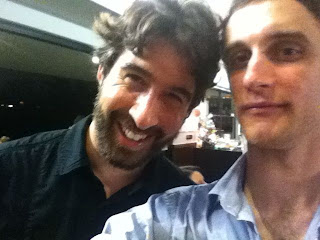 Mark and James often take photos together, so I asked them to take some snaps of the party with my iPhone. What I didn't realise is that they were walking around pretending to take photos of people, but were actually using the phone's front camera to take photos of themselves! Hilarious guys...
 Emma and Blake. Not sure if Blake knew how hard it was to take him seriously with that hat/jacket combo...
 Blake and me after realising our entry fee only got us two free drinks!
All in all, it was a pretty fun party and a great way to celebrate a big year. If the UQ Psyc Blog ever gets a budget of more than $0/year, I'll be sure to host a party for all our readers!
-Will
www.willjharrison.com


All in all, it was a pretty fun party and a great way to celebrate a big year. If the UQ Psyc Blog ever gets a budget of more than $0/year, I'll be sure to host a party for all our readers!
-Will
www.willjharrison.com
Tuesday, December 7, 2010
Excuses excuses...
Well the UQ Psyc Blog is back after a brief hiatus. Life has been busy for all the bloggers - conferences, holidays, confirmation seminars, assignment and exam marking, and data collection are just some of the excuses I won’t use to justify why there hasn’t been a new post in a while. What I will use, is this (be sure to watch in full 720p):
That’s a “teaser” video for James and my experience at Psychonomics, a cognitive psychology conference held in St Louis, Missouri, USA. I presented a poster about my work on OKN, and James presented a poster about his work on how unexpected visual events catch our attention.
While we obviously had a lot of fun, a conference is by no means a holiday - if you get a chance to go to a conference, you are there representing yourself professionally, your supervisors and their reputation, and your university. So even though the 30 hour trip to St Louis left James and I a little jet lagged, we couldn’t use that as an excuse when talking about our research, and especially not when talking to the big names in our area.
A definite highlight of conferences is getting to meet people you've only really read or heard about. In my case, this happened during a dinner we had with our supervisors and their colleagues. We got to meet Chip Folk, who, if you search for his article “Involuntary covert orienting is contingent on attentional control settings”, you’ll see has been cited over 700 times (and that's just for one paper co-authored by Roger, our supervisor). We also got to meet Shu-Chieh Wu who still works at NASA where she met Roger, and is another of Roger’s co-authors.
 From left: Chip, me, James, Shu-Chieh, Stef, Roger.
Conferences are a lot of fun, but they're also a lot of work. I'm certainly not complaining - in fact I've just submitted an abstract to attend another conference in 6 months!
Stay tuned for regular UQ Psyc Blog updates (again)!
That’s a “teaser” video for James and my experience at Psychonomics, a cognitive psychology conference held in St Louis, Missouri, USA. I presented a poster about my work on OKN, and James presented a poster about his work on how unexpected visual events catch our attention.
While we obviously had a lot of fun, a conference is by no means a holiday - if you get a chance to go to a conference, you are there representing yourself professionally, your supervisors and their reputation, and your university. So even though the 30 hour trip to St Louis left James and I a little jet lagged, we couldn’t use that as an excuse when talking about our research, and especially not when talking to the big names in our area.
A definite highlight of conferences is getting to meet people you've only really read or heard about. In my case, this happened during a dinner we had with our supervisors and their colleagues. We got to meet Chip Folk, who, if you search for his article “Involuntary covert orienting is contingent on attentional control settings”, you’ll see has been cited over 700 times (and that's just for one paper co-authored by Roger, our supervisor). We also got to meet Shu-Chieh Wu who still works at NASA where she met Roger, and is another of Roger’s co-authors.

Conferences are a lot of fun, but they're also a lot of work. I'm certainly not complaining - in fact I've just submitted an abstract to attend another conference in 6 months!
Stay tuned for regular UQ Psyc Blog updates (again)!
Wednesday, November 3, 2010
Come hear the UQ Psyc Bloggers talk about our research!
Did you know PhD students contribute to about 50% of all the research published in the School of Psychology?
This Friday, 5 November, the School of Psychology is holding the inaugural Research Higher Degrees Day. 16 students from very different areas in psychology will be talking about all the cool things they've discovered during their PhD research.
Contributors to this very blog will be well represented on the day. Here is a list of our resident bloggers' presentation times and titles:
I'll leave you with the first slide of my presentation which will hopefully be indicative of the style of presentation I'll give, as well as arouse your interest in the subject of my presentation!

This Friday, 5 November, the School of Psychology is holding the inaugural Research Higher Degrees Day. 16 students from very different areas in psychology will be talking about all the cool things they've discovered during their PhD research.
Contributors to this very blog will be well represented on the day. Here is a list of our resident bloggers' presentation times and titles:
- 10:20 - 10:40am Rachel McDonald "Conflicting norms: Do multiple groups matter?"
- 11:20 - 11:30am Katie Greenaway "Of aggression, desire for money, and belief in psychic octopi: The strange and sundry effects of lacking control"
- 1:50 - 2:10pm Will Harrison "OKN suppression, perceptual mislocalisations, the universe, and you"
- 2:10 - 2:30pm Joyce Vromen "Does the spider always win the fight for attention? Top-down modulation in fear-relevant Interference"
- 3:30 - 3:50pm Matt Thompson "The psychology of crime-scene fingerprint identification"
- 4:10 - 4:30pm Nonie Finlayson "Attention! And the depths we go to capture it"
I'll leave you with the first slide of my presentation which will hopefully be indicative of the style of presentation I'll give, as well as arouse your interest in the subject of my presentation!

Tuesday, November 2, 2010
A reply to a reply to the zero sum game: Should PhD students tutor?
A couple of people have asked me what I thought about Stefanie's comments about tutoring.
I think she makes a good argument for the benefits of having a strong publication record. She is correct in saying that it is very difficult to get short-listed for a job without a strong track record. And I would certainly agree with her central premise that any time spent away from publishing might not be helping you get a job, but only if you are aiming to create your own job through applying for a competitive postdoc or if you are applying for a research only position.
Given, however, that the majority of positions that are advertised are teaching and research oriented positions, then I would argue that tutoring and perhaps teaching a course or two can be valuable experiences during your PhD. I have been on several selection panels for teaching and research positions, and candidates who have had amazing publication track records have not been short-listed, or not been successful at interview because they were not able to demonstrate an ability to teach the required courses.
It is also worth keeping in mind that if you are looking at jobs within Australia, there are many more positions outside of the GO8 universities than there are within the group of top tier universities. Most of our graduates aspire to work at research intensive institutions, however by not looking for opportunities more widely, graduates may miss out on some interesting and enriching jobs. Many of the lower ranked universities now have extensive research aspirations, however when recruiting new teaching and research staff, especially for entry-level positions, they place a strong emphasis on demonstrated teaching ability.
Graduates may be reluctant to apply for these positions due to a fear of having a high teaching load, however, with some planning and negotiation, it is possible to strike a balance between teaching and research. One of the great benefits of working at universities with a different culture is that recent graduates are given a great opportunity to grow both personally and professionally.
There are two other benefits of teaching that I think can sometimes be overlooked. First of all is that I don't think you truly come to grips with a research area until you have to stand up and explain it to a room full of people. It is a great way to learn more about areas of psychology that may be related to your research. Many of my research ideas have come from having to teach courses in psychology and law and social cognition. The regularity of teaching also trains you to become more disciplined in how you research topics, as you have to manage your time carefully.
The second benefit, as I see it, is that teaching gives you a chance to actually talk to students. It is by spending time with students and engaging them in the areas of research that you are an expert in that you interest them in psychology, and perhaps even your area of specialisation. I know that I would not have been successful in recruiting some of my early students if I hadn't done some teaching at the end of my PhD.
Now, all this is not to say that research is not important, quite the opposite. You have to strike a careful balance between publishing and teaching, and so my point is that you should do both. It is very easy to think that teaching is not important or valued, even after you get a teaching and research position. I think this is partly due to the mixed messages academics sometimes receive. Universities don't run as a monolithic organisation (despite how it seems), and the research goals and teaching goals are managed by somewhat separate parts of the university. Not only that, external pressures operate on these two goals at different times.
There has been a lot of noise lately in Australia about the ERA, which is the research quality assessment framework by which universities will be compared. This has generated a lot of focus on research productivity. There are however, major changes coming in how universities are evaluated and compared in terms of their teaching quality, and so we should all expect there to be a greater focus on this shortly. Not only that, but there is a growing awareness that teaching quality impacts directly on student outcomes such as attrition (which is a very expensive problem for universities), as well as demand for courses. And let's be completely honest here, it is through undergraduate students wanting to take our courses that we can afford to spend time on research.
So in sum, you should think about teaching and research as being inter-twined rather than separable. Doing each of them well enhances your ability to do the other. Excellent research attracts students, both at the individual and institutional level. Excellent teaching attracts research students at both levels as well.
(I wrote this at the start of UQ's Teaching and Learning Week, during which it was announced that UQ had won the maximum number of national teaching awards possible…)
Dr Blake McKimmie
Note: While I am the Deputy Head of School (Teaching and Learning), these comments reflect my own personal views on the matter!
I think she makes a good argument for the benefits of having a strong publication record. She is correct in saying that it is very difficult to get short-listed for a job without a strong track record. And I would certainly agree with her central premise that any time spent away from publishing might not be helping you get a job, but only if you are aiming to create your own job through applying for a competitive postdoc or if you are applying for a research only position.
Given, however, that the majority of positions that are advertised are teaching and research oriented positions, then I would argue that tutoring and perhaps teaching a course or two can be valuable experiences during your PhD. I have been on several selection panels for teaching and research positions, and candidates who have had amazing publication track records have not been short-listed, or not been successful at interview because they were not able to demonstrate an ability to teach the required courses.
It is also worth keeping in mind that if you are looking at jobs within Australia, there are many more positions outside of the GO8 universities than there are within the group of top tier universities. Most of our graduates aspire to work at research intensive institutions, however by not looking for opportunities more widely, graduates may miss out on some interesting and enriching jobs. Many of the lower ranked universities now have extensive research aspirations, however when recruiting new teaching and research staff, especially for entry-level positions, they place a strong emphasis on demonstrated teaching ability.
Graduates may be reluctant to apply for these positions due to a fear of having a high teaching load, however, with some planning and negotiation, it is possible to strike a balance between teaching and research. One of the great benefits of working at universities with a different culture is that recent graduates are given a great opportunity to grow both personally and professionally.
There are two other benefits of teaching that I think can sometimes be overlooked. First of all is that I don't think you truly come to grips with a research area until you have to stand up and explain it to a room full of people. It is a great way to learn more about areas of psychology that may be related to your research. Many of my research ideas have come from having to teach courses in psychology and law and social cognition. The regularity of teaching also trains you to become more disciplined in how you research topics, as you have to manage your time carefully.
The second benefit, as I see it, is that teaching gives you a chance to actually talk to students. It is by spending time with students and engaging them in the areas of research that you are an expert in that you interest them in psychology, and perhaps even your area of specialisation. I know that I would not have been successful in recruiting some of my early students if I hadn't done some teaching at the end of my PhD.
Now, all this is not to say that research is not important, quite the opposite. You have to strike a careful balance between publishing and teaching, and so my point is that you should do both. It is very easy to think that teaching is not important or valued, even after you get a teaching and research position. I think this is partly due to the mixed messages academics sometimes receive. Universities don't run as a monolithic organisation (despite how it seems), and the research goals and teaching goals are managed by somewhat separate parts of the university. Not only that, external pressures operate on these two goals at different times.
There has been a lot of noise lately in Australia about the ERA, which is the research quality assessment framework by which universities will be compared. This has generated a lot of focus on research productivity. There are however, major changes coming in how universities are evaluated and compared in terms of their teaching quality, and so we should all expect there to be a greater focus on this shortly. Not only that, but there is a growing awareness that teaching quality impacts directly on student outcomes such as attrition (which is a very expensive problem for universities), as well as demand for courses. And let's be completely honest here, it is through undergraduate students wanting to take our courses that we can afford to spend time on research.
So in sum, you should think about teaching and research as being inter-twined rather than separable. Doing each of them well enhances your ability to do the other. Excellent research attracts students, both at the individual and institutional level. Excellent teaching attracts research students at both levels as well.
(I wrote this at the start of UQ's Teaching and Learning Week, during which it was announced that UQ had won the maximum number of national teaching awards possible…)
Dr Blake McKimmie
Note: While I am the Deputy Head of School (Teaching and Learning), these comments reflect my own personal views on the matter!
Subscribe to:
Posts (Atom)