Wednesday, April 14, 2010

“You’re too comfortable…but I like it.”

 The Psyc Conference -- Part II


At first it was strange sitting at the table with high ranking academics at the EPC dinner. I felt unworthy, and a little out of place. But it soon became clear that they weren’t interested in maintaining my delusions of inferiority. They, like me, just wanted to relax after an exhausting day of talks.

So I gradually became less inhibited and, before I knew it, I was speaking as though I’d known these people for years and we started to banter. But I thought I’d gone too far when one of the top vision scientists in Australia said to me, “You’re too comfortable…but I like it.” I shat myself and thought I’d overstepped the mark.

But he went on to tell a story about the late great physicist Richard Feynman. As a grad-student, Feynman stood-up and questioned the Nobel prize-winning Niels Bohr during his talk. Feynman later shat himself when he was ushered to Bohr’s chambers for “discussion.”

But it turns out that Bohr sought out Feynman because most physicists were too in awe of Bohr to argue with him. Feynman had no such inhibitions and said he felt as much respect for Bohr as anyone else, but once anyone got him talking about physics, he would become so focused he forgot about social niceties.

Academic etiquette in the 40s was a little different to the way things are now. I doubt a first-year PhD student like me would be allowed to sit at the same table as full Professors, let alone engage in some pretty risqué banter. I love this change and really appreciate being treated like an equal. (Some have even added me on facebook!)

So whoever your academic heros are, when you read their awesome work and see the impressive things they’ve achieved it’s easy to forget, they’re just people — don’t be afraid of getting too comfortable ; )

Matt Thompson
mbthompson.com

Click here to see Part 1!!!

Click here to see Part 3!!!

Are you studying Psychology@UQ and want to contribute to theuqpsycblog??
Send Will an email to find out how: will.harrison@uqconnect.edu.au

Tuesday, April 13, 2010

Conference hangovers are so worth it.

 The Psyc Conference -- Part I

Matt, James and I just returned from Melbourne where we attended my first Experimental Psychology Conference, and it has been one of the best experiences of my life! I had my nerves tested when I presented some data to a packed lecture theatre of academics from Australia and New Zealand, and then I had my liver tested when I celebrated my presentation on the first night, the conference dinner on the second night, and the goodbye party on the final night!

As great as some of the science discussions were, what really made the experience for me was all the crazy interactions outside of the conference. The conference dinner was certainly a highlight - a room full of experimental psychologists with a never-ending amount of beer, wine, and champagne... My abs got a great workout from laughing at all the things coming from academics' mouths!

As if partying until 4am with renowned academics wasn’t enough (one academic even stayed out until 6.30am on the morning of his own presentation!), but we also got to see what PhD students from other universities were like. They were all great - talking to students from Victoria and Western Australia for the first time was as easy as talking to my old friends down the hall at UQ. For example, at one bar where we were surrounded by people dressed in suits and drinking expensive wines, I spent 30 minutes talking with a student from the University of Western Australia about whether or not to include error bars on graphs! That’s pretty special (albeit extremely nerdy).

The UWA girls with Matt and I. From left: Matt, Rachel, Kat, Vanessa, and me.

I think the best part of the conference was the range of experience of the young researchers. Research assistants, Honours, Masters and PhD students all got involved, and all were really impressive. If you hear about a conference coming up that is in your area of interest - find a way to go! You don’t even need to present data - you can just go and see the sort of research being done by other people and make new contacts.

Three days later I’m still exhausted and I feel like I haven’t slept for a year. But it was all worth it - I’ve made some great new friends with students and academics, and I got some great feedback about my own research. It was also great fun to share this experience with two friends, Matt and James, and it makes me wonder what we’ll get up to in the future!

James and me... this must have been one of the 4am moments!

-Will
www.willjharrison.com

Click here to see Part 2!!!

Click here to see Part 3!!!

Are you studying Psychology@UQ and want to contribute to theuqpsycblog??
Send Will an email to find out how: will.harrison@uqconnect.edu.au

Sunday, April 4, 2010

Love and some Hate

On wednesday next week I am heading down to Melbourne for the 37th Australasian Experimental Psychology Conference (EPC). Although I've been to conferences before, this is the first conference at which I am presenting my own research and I won't lie, I'm incredibly nervous. The last few weeks have been a mad rush to get experiments finalised, data analysed and a coherent presentation put together.

Two weeks ago I was running what I thought would be my last participant through an experiment I plan to present next week at EPC. This particular participant was quite interested in the experiment and afterwards was eager to know more about what I was studying (always nice when someone shows an interest in what you're doing). I proceeded to debrief them.

As I was explaining the results the participant commented on my conditions and suggested that I had excluded one from my analysis. Slightly alarmed by this remark I attempted to clarify what they meant.

Their response: "I'm sure I saw such and such happen during the experiment."

I immediately felt sick, the participant had alluded to a potential confound in my design and there were only two possible explanations. Either they were asleep during the experiment and dreamt what they saw or there was an error in my code. Participants falling asleep during my experiments is not as unlikely as it may sound, it happens quite regularly. This particular participant seemed quite switched on though and I was immediately suspicious of the latter.

I opened the experiment and begun scouring through the code for the error. It didn't take long for my fears to be confirmed, the error was obvious. I began to stress a little. Without going into the details of the error I clung to the hope that it hadn't shown up in the data despite my last participant's testimony tending to refute the possibility. There is was though, where I had previously overlooked it, the error was blatantly obvious. I began to stress a lot.

So a long story short, I have been scrambling to rerun this experiment plus an additional experiment as well as trying to compile a presentation for EPC. Since monday this week I have run 41 participants across two and a half experiments. this includes running an entire experiment (7 hours of testing) on wednesday. The anxiety of potentially finding null results wreaked havoc on my sleeping patterns throughout the week.

I can report though that the results look fantastic for now and my presentation is coming along nicely. So onward to EPC where my results and presentation will likely be ripped to pieces by the academic elite. More sleepless nights ahead I suspect.


James Retell
Are you studying Psychology@UQ and want to contribute to theuqpsycblog??
Send Will an email to find out how: will.harrison@uqconnect.edu.au

Tuesday, March 30, 2010

Psyc update - 30th March 2010

First semester is well under way and the research is getting done!! I thought I’d give a quick summary of what’s been going on over the last month or so.

Conference Preparation
The first big local (Australasian) psych conference is coming up in a week or so. The Experimental Psychology Conference (EPC) is to be held in Melbourne this year and a large contingent of cognitive and perception psychs are busy getting their presentations and posters in order, booking flights and accommodation, and sussing out what mischief they can get up to when south of the border. While I’m not attending (Matt, Will, and James are, so stay tuned to see what they trouble they cause in Melbourne), I am keenly monitoring the process of creating a poster because I'll hopefully be presenting one in San Francisco later this year!

Confirmations
The first major milestone of the PhD is confirmation and tends to happen about a year into the program. Up until this point you aren’t technically a PhD student, you are a PhD candidate, which essentially means the university hasn’t committed to you or your research yet. You need to convince a panel, representing the school/faculty/university, that your planned research is interesting, innovative, and feasible enough to continue. Since a lot of the latest batch of PhDs started about a year ago we are having a lot of PhD confirmation talks. The ones I’ve seen so far have gone really well. It’s great to hear what projects other people have been beavering away at. I’ve found attending conftalks helps me overcome the facade of pretending to understand what my friends are researching. There are one of two outcomes for me: either I finally understand what they do, with the help of their finely-tuned explanations and diagrams, OR, I still don’t understand, which by this point is no longer hidden by the facade but exposed as glaring fact (“What do you mean you don’t get it? You were at my conftalk, right?!”)

Assassins’ League
I can’t give too much away about this, it’s terribly secretive (though I’ve already been chastised for blabbing to anyone who’ll listen). It’s a tense game of cat-and-mouse that lasts for two weeks, played exclusively among psych students and faculty, and not for the feint-hearted. I won’t say any more about the actual game but I will say that it’s a really fun way to get to know others in the school. Currently playing are a bunch of second-years, some masters students, some PhD students and some RAs. You never know who’s coming for you... Anyway, if you are interested in finding out more please visit this site.

So, fun times around the school. Almost makes a fella wanna do a PhD ;)

- Morgan

Are you studying Psychology@UQ and want to contribute to theuqpsycblog??
Send Will an email to find out how: will.harrison@uqconnect.edu.au

Friday, March 26, 2010

Freudian Slippers

Academia. My Dad was a UQ man, my husband is an academic, and I've been at Uni myself on and off since the mid-1980s - so I can't say I wasn't warned. For those who are curious, I'll attempt to describe a week in the life of a new lecturer.

Monday. Is supposed to be my writing day. My dropping-the-kids working-from-home writing-without-interruptions day. We're way into March and this is the first Monday that it's actually worked out. And I've woken up with a splitting headache and an upset stomach. Luckily I've just joined a writing group based on the helpful guide "How to Write a Lot". These writing groups are springing up all over the School: small cells of academics huddle together and contract to meet specific writing goals during the week to which they hold one another accountable. So I can't crawl back to bed and be sick. Must. meet. writing. goals.

Tuesday. Start the day with an hour of clinical supervision. I love clinical supervision. You get to work on fascinating cases without the direct responsibility for treatment. Today's cases include a teenager who has been badly bullied for his effeminate ways. I watch a DVD of a session in which the teenager is explaining his anger management strategies to my intern on the whiteboard. I'm proud of my intern. This client is going to be ok.

Lunchtime: RHD committee meeting (that's research higher degree). Due to the large numbers of RHD students in Psychology, including the large number of out-of-load PhD students (a parlous state that I myself am familiar with), Eric and co have worked up a set of milestones to help students keep on track: confirmation; mid-candidature review and thesis review. It's anxiety provoking for the students and its anxiety provoking for me because I now have 4 milestone meetings to chair and I'm falling behind. I wonder if it's possible to be out-of-load in my committee job?

Wednesday. Big day. There are 25 first year undergrads due to start my "Tuned In" program today – a music based emotion regulation program designed as an alternative to CBT. My Doctorate student Carly is leading six groups (3 now and 3 wait listed control groups) and we have interns as co-therapist in each group. I’m nervous about how the Uni students will respond to the program. Carly texts on Wed evening that they all turned up and gave the activities a go: drawing their imagery; describing their body sensations; the meaning of lyrics. Relief.

Meanwhile I'm giving an evening lecture to 150 third year students on Psychoanalysis. Freud’s theories are easily criticised in this place and time so I have to work hard to make them relevant and interesting. I consider wearing my Freudian slippers to the lecture but my superego wins and they end up on a slide instead.


Thursday. Meetings. An interesting meeting with Kim (the Director of Clinical Programs) and a visiting academic from NZ who is touring clinical programs here and in the UK to benchmark the way clinical training is done. Listening to Kim it’s hard not to catch his enthusiasm about what we're doing.

Friday. Start revising a rejected paper in preparation for our writing group at 2. Everyone has met their goal this week and Natalie gives us immediate chocolate rewards. More clinical supervision and then finally 4pm Friday comes around – staff club time. Everyone said the first year with all new teaching, new systems and policies to figure out is a killer. It is. But the rewards are great. So far so good anyway....

-- Gen Dingle

Are you studying Psychology@UQ and want to contribute to theuqpsycblog??
Send Will an email to find out how: will.harrison@uqconnect.edu.au

Tuesday, March 23, 2010

BRAINS!

Check. This. Out.

It’s not every day you literally get to see inside your own head. Last year I participated in a brain imaging study. My friend who was running the study just emailed me videos of the scan of my brain and I can’t stop watching them!!!

The first video is a scan going from the front of my face to the back of my head. You should see the vague outline of my nose, then eyes, then frontal lobes appear. At this point I’d like to thank my frontal lobes for giving me the ability to create blogs and such a hilarious personality.


This next video slices through my head horizontally starting from the left side. The first thing you’ll see is my left ear, and then the left side of my brain. If you pause the video about half way, you should see my corpus callosum. It’s the white thing that can be found right in the middle of my head and kinda looks like the top of a mushroom. It’s also the bit that connects the two sides of the brain. You might remember my blog post where I mentioned that Kim Peek was missing this part of his brain!


I was quite hesitant to post these videos because I feel like there’s something really personal about them. It’s kinda like people are seeing me stripped of my clothes, but in a completely different way to me being left naked. If consciousness is purely a result of what’s happening inside the brain, then these videos are really the most bare I can be. Weird.

Will Harrison. (Click here for my personal website.)

Are you studying Psychology@UQ and want to contribute to theuqpsycblog??
Send Will an email to find out how: will.harrison@uqconnect.edu.au

Tuesday, March 16, 2010

Tutoring Take Two

There’s something very energising about the start of a new academic year. For those of us not yet jaded by the research process it brings with it the prospect of new and exciting research ideas and results. For others it may invoke stresses and anxieties as you prepare to meet the challenges of yet another fast paced and hectic year. Adding to the excitement and the atmosphere of a new year is of course the return of students, in particular the new cohort of first year students who, this semester, have flooded the department in unprecedented numbers.

Last semester I was given the opportunity to tutor first year statistics and this semester I’m back at it again, out of the lab and into the tutorial room. Although I have no experience with which to make the comparisons, it would seem that tutoring first year students is in some ways quite unique. Unlike students in later years, first year students enter the tutorial room unsure of what to expect, filled with the anxieties of entering a foreign environment yet with an eagerness and enthusiasm to learn.

For a large number of my students, my tutorials represent their first experience in a University learning environment. This lack of experience and freedom from expectation as to the format a tutor and tutorial should follow, affords me a certain freedom to define my role as a tutor and the forum in which I teach.

I believe it’s very important to create an environment where students feel free and confident to question anything and everything I say. I know when I went through undergraduate I always viewed my tutors as exceptionally intelligent people (which I’m sure for the most part they were) but also that they were always right and that they new better than me. Certainly from my experience as a tutor this could not be further from the truth.

So if you’re a student reading this, my advice is to never let your curiosity go unsatisfied. Tutors are there to facilitate your learning not to “teach” you the material. So engage with your tutors and take the opportunity to put forward your own ideas. As well as benefiting the students it’s also a rewarding experience as a tutor when my class engages with me in discussion of ideas.

If I haven’t been made to look silly in front of my class at some stage throughout the semester then my students haven’t done their job. I can report though that I’ve been caught out more than once this semester already and it’s only the second week of tutorials...

All the best for the year folks

Are you studying Psychology@UQ and want to contribute to theuqpsycblog??
Send Will an email to find out how: will.harrison@uqconnect.edu.au

Tuesday, March 9, 2010

Share the Experience


The best thing about a PhD is the people you get to work with. I share an office with human factors and organisational researchers, I lunch with cognitive neuroscientists, and argue at a journal club with evolutionary psychologists. This diversity creates unique opportunities.

Recently, the HFES-UQ Student Chapter organised a field trip to a local hospital to check out Tobi's PhD work. Tobi has set up a patient simulator in an Intensive Care Unit (ICU). It's a $50,000 doll that breathes, blinks, has a pulse, takes real drugs, and pisses its pants. I thought the study was amazing but, of course, this was all in a day's work for Tobi.  

The PhD is often a very personal experience. But I think sharing that experience with fellow post-grads, who are likely suffering the same problems and experiencing the same daily roller coaster of emotions as you, is really important. So show your comrades your lab, clinic or field study. It may seem mundane to you, but I'm sure we'll be sufficiently impressed by your brilliance!

Matthew B. Thompson
President HFES-UQ


The control room -- eye tracker, head-cam, two HD field cameras and the mannequin control system.


Are you studying Psychology@UQ and want to contribute to theuqpsycblog??
Send Will an email to find out how: will.harrison@uqconnect.edu.au

Friday, March 5, 2010

Questions unanswered

Stuck in the middle ground between earning a degree and starting a PhD means I am often easily confused. I, therefore, ask lots of questions. Actually, scratch that. I would like to ask lots of questions. I don’t, which is probably linked to my initial comment about being easily confused. I don’t often know what’s a sensible question, which, when asked, announces to my peers that I am an intellectual, or what’s an insensible question, which, when asked, exposes me as the fraud I am.

What stops me asking questions? Many things, though mostly it’s my interior monologue second-guessing myself. Is my question relevant? Has it already been covered? Am I wasting time by asking it? Should I already know the answer? How can I put my question into words? How do I put it into words AND sound smart?!

This cloud of confusion suddenly lifted in spectacular form last night. I, along with 1500 of Brisbane’s atheists, evolutionists, and critical thinkers, enjoyed a public lecture by Prof. Richard Dawkins about his current book ‘The Greatest Show on Earth’. Richard went through each chapter of his book and summarised the most important parts for us/those that hadn’t read the book. It was when he covered Chapter 11: History written all over us, that my ears piqued. Richard said:

Look at whales, they have land animal written all over them. Even look at humans, they have aquatic animal written all over them.

Aquatic..?! He didn’t mean....?! No....

From this point on I had it. I was going to ask Richard Dawkins a question!! My interior monologue started playing up but I fought hard to quash it. I spent the rest of the Richard’s lecture thinking about how to ask my question and how to look suitably intelligent in the process (half of the psychology school was there after all :P ) The lecture finished and the audience was called up to microphones located at the front of the auditorium to ask questions. After a moment of deliberation I shot up and squirmed through the stalls to get to the microphone. Knee-caps shaking with anxiety, but with a calm and collected face on, I waited for my turn.

In the end I didn’t get to ask the question. Richard could obviously tell I was going to say something amazingly profound to stump him, or that I was going say something profoundly stupid and look like an idiot. Either way he called the question-asking short, just before I could ask mine. For those of you that care I’ve written it in full below.

Relating this back to asking questions, I actually learnt during my undergraduate degree that asking questions in lectures is a really efficient way of clearing up areas of uncertainty. Somewhere between graduating and floating around the psych halls I forgot that. Maybe it’s my (falsely-held?) belief that once you have a degree you’re actually supposed to know something and I felt I didn’t. I’m not so sure. Regardless, students should ask lots and lots of questions and I will endeavor to do the same.

- Morgan

“Richard. When you were talking about the huge history within us you mentioned that whales have land animal written all over them and that we even have aquatic animal written all over us. I trust you didn’t mean aquatic in the sense of Elaine Morgan’s aquatic ape theory (theory in second sense)? I understand this has been rigorously challenged and perhaps debunked. Do you think that interpretations of evolution, such as Elaine’s, hinder or help the communication of evolution to the lay-person?”

Tuesday, March 2, 2010

I’ll have what she’s having: Faking it in academia

At start of the second year of my PhD my supervisor told me it was TIME. I don’t want to name names, or implicate anyone in criminal activity, so for the sake of maintaining anonymity let’s just call my supervisor “Dr Winnifred Rose Louis”. Winnifred said to me, “Barlow, my good lass, it’s time you presented your research at a conference.”

The conference was the annual meeting of the Society of Australasian Social Psychologists, and the year was 2006. Obeying the command of my supervisor, if not the dictates of my own heart, I accordingly submitted an abstract, was accepted, packed my bags, and jetted off to Canberra. I was not, however, a calm little academic.

My main concerns ran as follows:

1. My research will be publically debunked.
2. My inadequate grasp of the intricacies of the literature will be brought to light.
3. The other academics will hate me.
4. I will hate the other academics.
5. My shyness will overcome me in all possible embarrassing ways.
6. In general, I will be discovered for the fraud that I am.

Now these fears may come as quite the surprise to those of you who know me. I am aware that nowadays my booming voice regularly rings through the psychology halls, engaged in lively debate with my fellow empiricists. But back them I was a green, wet behind the ears PhD student, and I was absolutely paralyzed by fear at the thought of strategically networking with fellow researchers. It was primarily that word, “networking”, that had me running scared. I had always thought of networking as a bit of a dirty word – I had an idea that it consisted of schmoozing and romancing people that I did not like or respect, all in a desperate bid to get ahead.

And yet… Winnifred had spoken and I had obeyed. There I was, at my first conference, sick to my stomach, and feeling woefully inadequate. My talk had, despite my worst fears, gone off smoothly. I came across as a passionate and engaged young thing, and those who attended were universally kind. That was all well and good, but the highly structured presentation was not what I was worried about – it was what was coming next.

“There are some people that would like to meet you Fiona, and that I would like you to meet.” Winnifred told me after my talk. “We are about to go and have drinks at the poster session, I will introduce you to them there.” Mouth dry and heart thumping, I escaped to my room. The social setting of the poster session made everything worse – how could I do this!?

It was at that point I made a critical decision – I would fake confidence. I would breathe deeply, straighten my back, beam a smile, and talk clearly. I, in my shy and retiring way might not be able to make it through networking, but I could certainly make an attempt at faking.

Both Men and Women can fake it.

Decision made, I marched down the stairs to the conference room where the poster session was being held, and bravely faced the waiting masses. What transpired next was a blur. Winnifred shepherded me from person to person, and eventually, confident that I could navigate the vicinity on my own, left me. To my surprise, that afternoon and in to the night I met a range of fantastic people – researchers who like me were passionate about racism and discrimination, people who could chat about statistics and theories and the wonderful phenomena of existence that we study in psychology. Suddenly, networking wasn’t so scary or so crass – really it was just chatting to people who were interested in the same things as me, who found a joke about regression funny like I did, and who could tell me personal anecdotes about the researchers that I admired.

I still maintain friendships and collaborations with researchers that I met at that first conference. When I see them at conferences now it is like a family reunion, and I am thankful that I had the presence of mind to fake what I could not legitimately produce that first time.

To this day I still fake it – producing a facsimile of confidence when I feel none, and cracking a seemingly off-the-cuff joke in my lectures that is in fact elaborately rehearsed and ruminated about. But those times are rarer, and what was once acting has become a reality – I can genuinely enjoy conferences, dinners, networking and public speaking. I suggest that this is the way that it is for most of us. We take a while to find our feet and engage with other academics outside of the comfort zone of UQ (or even here as new PhD students!). But the benefits of engaging through public speaking and networking are intellectually stimulating, socially rewarding, and infinitely valuable for our future careers. I urge you all to attend every conference you can, to present your research in a talk rather than a poster session, and to choke down your fear and approach the academics that you would love to chat to. Although scary, I promise you that it will be worth it – and remember, clichéd as it is, faking it until you make it is a fantastic approach to take.

Tuesday, February 23, 2010

“It’s alive!”: A social scientist discovers physiology

I am a social psychology PhD student, and proud of it. I love my research – it’s loads of fun and I’m generally not hampered by a lot of the constraints that students in other areas of psych tend to face. For me, no specialized equipment required; paper and pencil are my weapons of choice. No crash course in computer programming at the start of my PhD: my first study (N=120) was run in the refectory area on campus. In about an hour and a half.

Yep, I was leading the methodological good life. Until I realized that my research questions aren’t totally answered by self-report measurements. You see, I study the effects of global threats on intergroup relations. A main problem of threat is that sometimes it’s so threatening that people just switch off and deny that it’s there. I’m beginning to find strange patterns in my data where sometimes people in my low threat condition report being just as threatened as people in my high threat condition.

So how to deal with this problem? I decided I needed to a radical new approach. I needed to tackle this problem head (and body) on. In short, I needed…physiological measures. A few weeks on from this decision and I’ve entered a turbulent world full of heart rate, skin conductance, startle eyeblink, and facial electromyography. I won’t lie, approaching a whole new methodology in my final year of data collection is a big step, and is more than a little threatening in its own right. But it’s also liberating and exciting and opens up a whole new avenue of potential research questions.

The best lesson I’ve learned during this process is a simple one. No one methodology is infallible; a research question needs to be approached from multiple angles to really get a full picture of the human experience. A pretty basic principle, I know, but often it’s easy to get stuck in a methodological rut. We get such a short time to really immerse ourselves in a PhD topic that when we find something that works, we often stick with it. I’ll update everyone on how my personal quest for methodological rigor goes…

Are you studying Psychology@UQ and want to contribute to theuqpsycblog??
Send Will an email to find out how: will.harrison@uqconnect.edu.au

Friday, February 19, 2010

if coffee == TRUE { output = output + 1 }

It kinda feels like I only need two resources to survive while I’m doing my PhD - caffeine, preferably in coffee form; and data, which come in many different forms. So I’m working on a new law, kinda like the laws that govern our universe. But so far my law is far more simple than thermodynamics: more caffeine results in more output.

Recently I’ve been dealing with data collected from an experiment where I record what people are doing with their eyes during an experiment. Every 0.002 seconds I sample X and Y co-ordinates of where someone is looking on a screen. Given that the experiment goes for about 20 minutes, I’m collecting over one million pieces of data per participant!

Obviously there’s not enough coffee in the world to make anyone go through each of those data points one by one, so I automate all of my analyses. But automation takes a lot of hours of programming, and therefore a lot of cups of coffee. When programming there is always a solution to any problem, error or bug that arises, and if you’re like me you have to keep working at it until you solve it.

So - I’ll share some data that I’ve managed to process and graph (more caffeine results in more output). Each line on the graphs below represents one eye movement. People were meant to be looking around the four corners of a box, while I flashed targets inside and outside the box. The graphs are actually the same, but the one on the top is the raw data, whereas the graph on the bottom has all the “cheat” eye movements (where the participant looked directly at the target) removed. For more detail, click the graphs.


These graphs represent roughly about two months of my life, or about 120 cups of coffee! The time it took to remove those few lines alone took about 20 hours of work, or four cups of coffee. But like I said before, the more coffee I drink, the more output I create - and now using the program I have written I can process the same amount of data as graphed above in just a few clicks of my mouse.

For anyone planning on doing research I recommend testing out my law, more caffeine equals more output. I guess it doesn’t matter if it doesn’t work for you - just come up with your own as long as it ends with “equals more output”!

Are you studying Psychology@UQ and want to contribute to theuqpsycblog??
Send Will an email to find out how: will.harrison@uqconnect.edu.au

Wednesday, February 17, 2010

Facing the Reality of Research


If all goes to plan, this blog post will hopefully serve two functions. First, I hope to introduce you to what I consider to be a rather cool illusion related to face perception. Second, it will serve as a forum for me to vent my frustration at having recently discovered a research idea of mine has already been published in a prestigious journal.

In my spare time of late I’ve been perusing the face perception literature. It has been well documented that presenting a face upside-down dramatically affects its recognition. So much so that you may even mistake the identity of the image for someone else. You may have experienced this for yourself perhaps when looking at a paper that someone else is reading from across the table. Initially the person on the front cover is difficult to recognise. “Who is that you think? Is that that creature from Lord of the Rings?” Upon snatching the paper from your friend and reorienting the image you realise you were mistaken and it is in fact Tony Abbott.

Without going into too much detail, this effect is thought to be the result of psychological processes involved in face perception that are tuned specifically to upright faces. A slightly more striking illusion that is thought to illustrate these same cognitive processes is the “Thatcher illusion”. The Thatcher illusion shows that it is difficult to detect local feature changes in an upside down face, despite identical changes being blindly obvious in an upright face. So what on earth does that mean? I’ll let the illustration below do the explaining.


The first image is of my adolescent crush Elisha Cuthbert. The second image is the same as the first except the eyes and the mouth have been inverted. Looks grotesque yes? The last image is one of the first two images upside-down, any guesses which one it is? The animation below should reveal the answer for you.


The illusion itself has been well documented. Where I thought I stumbled across something of interest was in looking at the angle of rotation at which the image appears to change from an “intact” face to a deformed image. Of those I’ve shown this to, some report a gradual change from one image to the other while others have report a sudden switch. Personally my perception of the image seems to flip when the rotation reaches a critical angle just beyond 90 degrees.
Alas, it would seem that this line of thought has already been investigated and I must return to the drawing board...


Are you studying Psychology@UQ and want to contribute to theuqpsycblog??
Send Will an email to find out how: will.harrison@uqconnect.edu.au

Friday, February 12, 2010

Exposing yourself as a student

Before the complaints come rolling in, the title of this blog post doesn't refer to the socially unacceptable activities that are often attributed to men in raincoats, rather it refers to the practice of getting one's name out there and becoming known within the department.

The importance of exposing oneself throughout your academic career is something that is only appreciated when you see the result of this exposure. This result can be very satisfying, as people will typically look at you in a very different way after you have put some serious effort into exposing yourself. Obviously exposing oneself comes with risks, but I am of the belief that these risks are far outweighed by the long-term benefits. I think that many students don’t expose themselves enough, so I thought I’d offer some thoughts on how best to go about exposing yourself:

Exposing yourself is really quite simple, but requires a bit of courage. It is all about getting involved in the department and the research area in which you contribute. Whether this be at a low level by introducing yourself to the senior academics that you may come into contact with (your lecturers), or at a high level by presenting your work at conferences where you will no doubt rub shoulders with the great minds in your field, exposing yourself is all about creating a presence and making yourself known.

I know of undergraduate students that are exposing themselves already, even without having reached postgraduate study. Whether it be by doing research assistant work for any number of academics, or acting as student representatives (and sitting on committees with senior academics), these practices get you known as a ‘somebody’ in the department. Some students even have the courage to attend conferences, even without having work to present. The more of this you do, the more you come to understand what being an academic involves, and the more opportunities may open up.

As a final point, and hopefully to drive home the importance of exposing yourself throughout your academic career, I once heard a senior academic frame the benefits of exposing oneself in this way:

“If you were looking to hire a new researcher and had two resumes on your desk which were identical in every way, but you knew one of the applicants (and liked them), which applicant would you hire?”

Are you studying Psychology@UQ and want to contribute to theuqpsycblog??
Send Will an email to find out how: will.harrison@uqconnect.edu.au

Friday, February 5, 2010

Getting to Know You.

If you are at all familiar with the PhD comics, then you’ll know that free food is the life-force of all post-grad students. Thus, a disproportionate amount of time is spent searching for, and acquiring, free food. Today was no exception.

First semester is fast approaching and today the psychology school hosted an Honours open day. School functions are always catered so, naturally, I inquired as to what this Honours open day was all about. Essentially, fourth-years have to submit their preferences for supervisors this Friday. It has been the case (certainly in my experience) that students only know the academics/potential supervisors that have taught them in the past. Students aren’t typically aware of just how many academics there actually are because a lot of them don’t teach. Today’s open day was designed to give students an opportunity to actually meet potential supervisors, including the ones they’d never heard of before!

Now, I’m no supervisor by any means (I’m not even a PhD student!) but I couldn’t pass up the opportunity to grab complimentary grub so I came along for the ride. In my opinion the open day was a great success. Everywhere I looked small gaggles of fresh-faced Honours students were gathering around prophetic academics. The academics themselves seemed to enjoy it as much as the students. I mean, what researcher wouldn’t enjoy talking about their work to people who might happen to think it’s amazing, let alone care? Subsequently, the academics were all highly animated, pitching their work and fighting for students’ interest against other academics with extravagant hand gestures, flashy brochures, and glitzy, Web 2.0-esque presentations.

If this post was to have any sort of message it would be this. I wasn’t fortunate enough to have an opportunity such as an Honours open day when considering my supervisor preferences, and I wouldn’t be surprised if students at other universities and schools were missing out on this opportunity too. So I’d put to upcoming Honours students (in any discipline) that you should really try and get to know the academics in your school. Academics are a highly agreeable bunch and you’ll probably find one that matches your research interests and your personality.

So, a successful morning AND I got free food. Winner in my opinion.


- Morgan
Are you studying Psychology@UQ and want to contribute to theuqpsycblog??
Send Will an email to find out how: will.harrison@uqconnect.edu.au

Tuesday, January 26, 2010

Tutoring for Fun and Profit

Well do I remember my first tutorial – so many thoughts running through my veins and emotions knocking about my head (or some combination thereof). Primarily, I remember thinking: “I hope that I don’t vomit” and “Why, oh why, did I choose to wear a transparent yellow dress?”.

Now, with a bit of luck your first experience tutoring wasn’t, or will not be, like this. But first tute nerves, that rowdy student, and mental blanks are inevitable parts of tutoring. Fear not, however, gentle reader – it is my firm belief that tutoring can not only make you money but can also be enjoyable (or less unenjoyable)!

So first, let’s cover some ground. If you are thinking of going in to academia you should tutor. Tutoring is a stepping stone to lecturing – and yes, odds are that if you go on in a university YOU WILL be lecturing. Tutoring looks great on your CV (especially if you tutor across a variety of subjects) and gives you invaluable experience for the further teaching that WILL come (until, of course, you score that amazing fellowship that allows you to turn your back on eager young minds).

We are gearing towards the end of January now, and as such, you will be starting to think about what classes to nominate for tutoring, and I hope, reflecting on how you can get through the tutoring semester with the least pain.

So, do a little mental exercise with me if you will. Take yourself back to a tutorial when you were a wee little undergraduate student. There you are – sitting in the back, chewing on the end of your indelible ink pen, and thinking of England. What did you wish for in that tute? If you were anything like me, you were thinking “Please, please, please, please stop boring me”, followed by “I’m hungry”. As a tutor you may not be able to do anything about the second point, but as for the first, well there are a few simple things that you can do to make tutorials less boring for your students, and yes, for yourself!

Students, like animals, will respond to your mood. In short, if you are afraid, they will sense it. Tutors and lecturers who get positive TEVALs uniformly report that their most common positive comment from students regards their enthusiasm. Students want desperately to feel excited about their field of study – and as tutors you are often the only teachers who talk to them personally, and infect them with the psychology bug. Whatever you may be tutoring, think about what you love about psychology, and try to communicate it to the students. Maybe you are tutoring something that is traditionally dry (like stats), or in a course that you are not familiar with. But my money says that you can still find things there that will peak the students’ interest. For me, while teaching stats, I consistently think about the amazing findings that stats unearth. ANOVAs may be boring, but when I, the intrepid explorer, employ an ANOVA to unearth an amazing finding about human existence, suddenly ANOVAs are just that little bit more sexy.

Aside from enthusiasm, I always like to inject a little bit of unrelated fun in to my tutes (and now lectures). Add a picture or two to your slides, begin your tutes with music, and tell an amusing anecdote that relates to the content of the class that you are tutoring. You may feel like a complete dork in doing so, but odds are your students are dorky too, and will appreciate your effort. Students (like romantic partners) love to feel that you are going that extra mile for them.

So, to conclude – I hope that my little pep blog has inspired you to be the tutor that I (and Tony Robbins) know that you can be. I will now end with two of my favourite and most memorable tutoring moments:

1. 1. Leading my PSYC1030 students in an example relaxation exercises, one of my students got a little too comfy and let out the most gargantuan fart. The class erupted in giggles that quite literally lasted for 10 minutes.

and

2. 2. Feeling overtired, I wrote my meanest comment on a failing PSYC3020 essay that I ever wrote – I said “you and I both know that you can do better than this”. I felt terrible about it for ages – until, that is, I received this student’s second assignment in which they had taken the comment to heart, worked incredibly hard, and scored a 7!

Good luck guys, and happy tutoring!

Love, Fi Barlow

studying Psychology@UQ and want to contribute to theuqpsycblog??
Send Will an email to find out how: will.harrison@uqconnect.edu.au

Friday, January 22, 2010

What a day...

Today I have been through all the emotions: highs, lows, hunger, and fatigue. After conducting a year’s worth of research, I have spent the past few weeks writing a draft of a report to submit to a scientific journal. My co-authors and I met today to discuss my draft, but instead, I dropped a bombshell. I’ve been deliberating for about a week about what I was about to say, and just before the words leapt from my mouth, my heart first nearly leapt from my chest. I said, “We need to trash everything. We need to start all over again.”

It felt like the pain of having to say that to my colleagues was reflected by the looks on their faces in response. In retrospect, maybe I should have started the conversation with the justification for that statement, rather than hitting them first and then explaining why. So, let’s wind back and I’ll explain my thought process.

I’m determined to get published in a high impact scientific journal as soon as possible, and the research I’ve been working on could be the one that hits the mark. When writing the draft of the report, I had to get into the mindset of “this really is the best research ever”, to ensure that I conveyed the importance of our findings in the writing. And it worked - I drafted a very simple, convincing story based on a lot of previous literature, and I managed to emphasise the importance of what we were adding with our new experiments.

Unfortunately, regardless of any self-ego-boosting, I couldn’t convince myself that the way in which we conducted the experiment was optimal. In fact, some of our more interesting results were found by accident - after the first, main experiment, we realised that we lacked certain controls. We quickly designed a follow-up control experiment and collected some data. When we were looking at the new data, we realised that the control experiment didn’t really control for anything, but we found a new effect that hasn’t been reported by anyone else! Crazy!

But what would have happened if we included the controls from the beginning? Would the results be the same, or would they be completely boring? And this is the hurdle I just couldn’t climb over. If we did get this research published in a high-impact journal, other research groups would try to replicate our results, and if THEY employed controls from the beginning and didn’t find an effect, then we would be in a much worse-off place than when we started.

After a quick estimation, re-testing will take approximately 80 hours in total plus all the data analysis, and, after all that, the amazing effect we found might disappear. But now I have convinced myself this is completely necessary: I don’t want to be known for having reported something that doesn’t exist, and if the effect survives the re-testing, we know for sure we are onto something amazing.

Are you studying Psychology@UQ and want to contribute to theuqpsycblog??
Send Will an email to find out how: will.harrison@uqconnect.edu.au

Tuesday, January 19, 2010

Dusting for Prints


In my PhD I work with police officers on the fingerprints they find at crime-scenes. But trust me, neither my work nor theirs is anything like CSI Miami. But occasionally exciting things do happen.

Last month I went to Queensland Police Headquarters and learnt to lift and photograph fingerprints. The officer teaching us probably thought it was mundane but Morgan and I were stoked. We used magnetic powder to dust Coke bottles, CDs and weapons. It was amazing seeing my own own fingerprints appear from nothing right in front of my eyes.  It's not too difficult but will take lots of practice to get right.


Like most PhD students I spend hours sitting in front of a computer reading basic psychology research and designing experiments. This makes it easy to lose site of the big picture. But times like the above give me some much needed motivation from the realisation that we researchers are working to solve problems that will affect people's lives, hopefully for the better ; )

Matthew B. Thompson

Are you studying Psychology@UQ and want to contribute to theuqpsycblog??
Send Will an email to find out how: will.harrison@uqconnect.edu.au

Friday, January 15, 2010

Hard Work Has to Happen in the Learners' Minds

This week we were very fortunate to have renowned Harvard physicist, Professor Eric Mazur present three seminars at UQ. One hardcore academic lecture on optical physics (an area for which Eric is a world leader), and two seminars on teaching and lecturing style (another area for which Eric is a world leader). I decided to sidestep the optical physics lecture and attend the two teaching and lecturing seminars because effective communication of science is a skill I’ve recently become interested in.

Eric noticed that, while his students were passing his introductory physics course, most were only memorizing facts and not grasping the key ideas of his lectures. To show his students lacked conceptual understanding, he gave two forms of the same test, which were about content his students should have had a solid grasp; one test in traditional form that could be passed with rote learned knowledge, and the other test in conceptual form that required deeper understanding. What he found was that 40% of his students did really well on the traditional test, but tragically poor on the conceptual test. Only 10% of his students performed well on the conceptual test but, critically, they also performed really well on the traditional test.

Modestly, rather than assuming his students were stupid (a hard case to make about Harvard pre-Med students), Eric began looking at how he could change his teaching style to make it easier for his students to better understand those basic concepts. His eureka moment serendipitously occurred at a hastily-organised study session the panicked students requested after their dismal performance on the test they should have aced. Whilst trying to force the concept into his students’ brains with varying diagrams, some students who did understand the ideas were able to explain it to those who didn’t in terms they could appreciate.

The important discovery was that students who understand the content are also more likely to appreciate the barriers to understanding, having recently overcome them themselves. As an expert who had understood these ideas for more than 20 years, Prof. Mazur couldn’t remember what made them difficult to learn. He said “The longer you teach, the less qualified you become to teach.”

From this, Eric developed his Peer Instruction method, which can be seen
here. The method has become hugely popular in the US, where it has been shown to improve learning over twice as much as traditional lecture styles. We are now starting to see similar changes in how UQ lecturers think about teaching.

You can watch Eric’s lecture “Confessions of a Converted Lecturer” here and look at his slides here


- Morgan

Are you studying Psychology@UQ and want to contribute to theuqpsycblog??
Send Will an email to find out how: will.harrison@uqconnect.edu.au

Tuesday, January 12, 2010

Gamblin' man


It’s no secret to those who know me (and now you) that I enjoy gambling. Why so many of us engage in this insidious behaviour has been a focus of psychology research for many years. Personally I like to think that my tendency to gamble arises from an interest in and basic understanding of statistics. You only need to be vaguely familiar with the concept of gambling or perhaps have access to a dictionary to argue that I’m a fool. In my defence, I’m certainly not the type who strolls into a casino thinking I can win a fortune. Casinos and betting agencies employ statisticians far more competent than me to ensure that they win and I lose.

So when to apply the statistical knowledge endowed to me by psychology for my own personal gain? Fortunately people in general are far less adept at identifying true statistical patterns and reasoning out statistical problems than casinos. Last week I was in a bar with a friend who remarked “I’m not sure I know anyone who shares my birthday”, immediately I saw an opportunity to make some money. I bet them that there would be two individuals in the bar who shared a birthday. Was this a good bet?

My friend and I estimated there were at least 30 people in the bar, and being offered 2:1 odds that I was correct, I jumped at the bet. Did I make the correct decision? To answer this you need to know if the return on my bet is better than the odds of winning. That is, how many people are required in a group for there to be a greater than 50% chance that two of them share a birthday? If the number of people required exceeds 30 then I have made a bad bet.

The problem becomes easier to solve if you work out the probability that no one will share a birthday. In a group of two people the chance of no match is 364/365. Add a third person and the chance they match the first is 1/365 and the chance they match the second is also 1/365. Therefore the chance the third person does not match either the first or second is 363/365. To calculate the odds we multiply the fractions, 364/365 x 363/365, which gives a 99% chance that no one in a group of three shares a birthday or a 1% chance that they do.

As each person is added, the odds do not increase linearly, but rather they curve upwards rapidly. If you continue to apply this logic for a group of 4, 5, 6 and so on, up until a group of 23 people, you find that there is a 51% chance two people will share a birthday. It turns out in a group of 30 people there is a 70.1% chance that two people with share a birthday.

Without out the aid of formalised statistical methods it’s difficult in this case to arrive at the correct decision. This is why I enjoy statistics, they can often show the seemingly improbable to be quite the opposite. However, I didn’t actually compute these odds at the bar; I knew of them prior to the bet and thus was essentially hustling my good friend...


Are you studying Psychology@UQ and want to contribute to theuqpsycblog??
Send Will an email to find out how: will.harrison@uqconnect.edu.au

Tuesday, January 5, 2010

2009 Wrap Up!

Last year we launched the UQ Psyc Blog, and before we get too far into 2010, I thought I’d write a quick summary of what’s happened on the blog so far. We started the blog with the goal to share what it’s like to be studying psychology at the beautiful University of Queensland, and hopefully to share some of the cool things we’ve been learning along the way. In this post, I’ll share some of the blog data we’ve recorded so far!

In the 6 weeks Matt, Morgan, James, Stef and I have been blogging, we’ve had 204 different people visit the blog over 600 times! While most of our visits have been from Brisbane, people have read our blog in Canada, the US, England, the Netherlands, and even New Caledonia.

James’ post Genuine Magic or Supernatural Powers had the most views (60 people), while my post Things About the Brain You Don’t Really Need to Know, had the second most, with 47. (However, people stayed on my story for 30 seconds longer than on James’ – not that I'm competitive or anything.)

Over 50% of people who visit the UQ Psyc Blog arrived at the site via Facebook, most likely after having clicked on one of our self-promotions that we each share on Facebook every time a new blog post is written. On average, each visitor stays for about one minute and thirty seconds, which should be just long enough to read a single blog post.

As for 2010, we plan to have many more contributors, and we’ll continue to strive to post stories that will be of interest to everyone, regardless of their backgrounds or interests. As always, feedback is welcome, and if you have any suggestions, comments, or want to contribute to the blog, please write to me at the email address below.

Are you studying Psychology@UQ and want to contribute to theuqpsycblog??
Send Will an email to find out how: will.harrison@uqconnect.edu.au

Thursday, December 24, 2009

Happy Christmas, Gifts, and the Gifted.

I was originally going to post some photos from a recent celebration the School of Psychology had, but I stumbled upon an article that I thought was far more interesting. Nature’s website reports that Kim Peek passed away yesterday, 23 December, 2009. Kim had some amazing abilities, like being able to read two pages of a book at once - the left page with his left eye and the right page with his right eye.

Not only could Kim read two pages at once, but he could do it in about 10 seconds, and could read even if the book was upside down. As if that’s not enough, Kim retained about 98% of the information he read, and could recall any bit of information from any of the 9000 books that he had ever read!

Brain scans performed in the 1980’s showed that Kim was missing a corpus collosum - the membrane that connects the two halves of the brain. (If you’re interested in pictures of the brain scan, check out this article.)

These skills didn’t necessarily make Kim’s life easier. In fact, Kim was quite disabled and, when he was only a few years old, his parents were encouraged (but didn’t) admit him to a mental hospital and forget he existed. His motor and social skills were poor, and his father had to care for him 24 hours a day.

In the movie Rain Man, Dustin Hoffman played a character based on Kim Peek. Not only did the writer win an Oscar for this movie which he later gave to Kim, but the movie seemed to help Kim’s social skills. Kim himself said that he couldn’t look people in the eye until he met Dustin Hoffman.

Below, I have embedded part one of a five part documentary on Kim Peek that I encourage everyone to watch. As inspiring as Kim’s abilities were, to me Kim’s father, Fran, is also hugely inspiring. Fran showed amazing patience with his son, and his love and care for Kim is obvious in the documentary.


At the risk of finishing on a sad note, Fran’s Christmas will likely be a lonely one this year. But thanks to Fran’s love and constant nurturing of his son, the world got to meet Kim Peek and witness some of the brain’s amazing abilities. Thank you Fran for sharing your and Kim’s lives with the world - it was truly a gift.

Regardless of whether or not you celebrate Christmas, everyone from the UQ Psyc Blog would like to wish our readers a fun, relaxing and safe break!


Are you studying Psychology@UQ and want to contribute to theuqpsycblog??
Send Will an email to find out how: will.harrison@uqconnect.edu.au

Tuesday, December 22, 2009

What does it take to do a PhD?


Students often ask me whether I think they could do a PhD, or whether they should rather do a Masters, go clinical, etc… I got my PhD in Psychology two years ago, in Germany, and won a couple of dissertation prizes and so I guess you could say I was a successful PhD student. However, more importantly, I was a very happy PhD student. I didn’t do a Masters etc., but I can maybe tell you one or two things about the PhD. Obviously, what I’m going to say isn’t valid for every University, Department, or even every Psychologist at UQ, and your potential PhD experience will depend a great deal on your supervisor, but hopefully I can give you an impression of whether or not you would have a good time doing a PhD.

In general, I think, you’ll have a fantastic time as a PhD student if you’re cut out to be a researcher, that is, if you think, act and work like a researcher. What does it take to be a researcher? Here are some of my ideas – very subjective and idiosyncratic, obviously, but maybe it’ll help you.

First, researchers don’t have anybody who works out their schedule for the day, they have no direct supervision, no boss to tell them what to do. You, as a PhD student, will have your own project, and you’ll be ultimately responsible for the progress. There will be a million things you need to know (both knowing how and knowing that), but no one to teach you. Supervisors may be helpful or they may be a hindrance. You may have to seek advice from others, and teach yourself one or two things without anybody helping you. Do you believe that you can learn without a teacher? Or do you even like learning new things autonomously? That’s really essential. Another important factor is: Can you discipline yourself, and do the things that are necessary, instead of only the things you like best? That’s important for your progress.

Second, successful researchers usually come in two broad flavours: critical or creative. Have you ever been praised for your critical or creative thinking? Have you ever excelled in a course where this was demanded? If not, don’t despair. If yes, that’s a good indicator that you have what it takes to be a researcher (because our prime job is to extend the current knowledge pool).

Third, there’s a reason that the most successful researchers often seem to be absent-minded: They are really involved with their research, they think about their project all the time. They often put in more hours than just 7, 8 hours per day, and when they go home, they take their research with them. Are you capable of working 12-14 hours a day? Are you prepared to work on a weekend? Have you ever been really involved with a topic, up to the point of becoming real fanatic about it? That’s a great plus.

With motivation and discipline, you can obviously learn everything that’s required to do research. However, one important thing is writing skills: If you don’t have good writing skills, it’s going to be difficult for you. You may overcome these difficulties, but it probably won’t be much fun. So you may be off better choosing another good job instead of researcher/PhD student: No reason to make it harder for you, right?

Hope this helps!!! Cheers, Stefanie.
Are you studying Psychology@UQ and want to contribute to theuqpsycblog??
Send Will an email to find out how: will.harrison@uqconnect.edu.au

Thursday, December 17, 2009

Sense and Sensibility


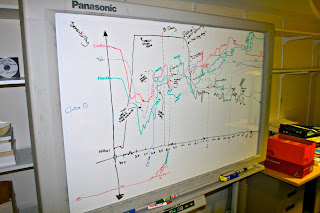
I am very fortunate to share an office with an awesome group of guys. Our office is known as ‘The Cave’ for the simple reason it is located deep in the dingy basement of the psychology building, down the hall from where experimental ‘participants’ are kept. We all realise the importance of enjoying the environment you work in (even a psychology basement) and have created the concept of office ‘vibe’, which simply aims to increase the inhabitants’ satisfaction with their working environment. When you walk into The Cave you can tell the place has vibe. Office members should aim to uphold vibe and never quash it.

The Cave inherited an old whiteboard that was just taking up space. Clinton, senior Cave inhabitant, remembered what an old designer friend had done with their disused whiteboard, and so the Sensibility Graph was introduced. Sensibility is a measure of how sensible someone is, or of how much sense they are making. The graph is quite simple, each office member is represented by a different coloured line. Time, in days, is along the x-axis and sensibility is along the y-axis, so the higher on the graph someone
is, the more sensible they are.

The graph has been going for a couple weeks and up until this point it has just been a bit of a laugh; office members would decide whether someone was being sensible or not and arbitrarily decide by how much. But let’s get serious here, we are scientists after all! This measure of sensibility needs to go through the rigor of the scientific process!

A future project of our pre-pub Friday afternoon festivities (known as Crafternoon) will be to work on the Sensibility Graph and the measure of sensibility so that is scientifically sound. Perhaps the most exciting idea will be assigning values to the graph (why didn’t this occur to us earlier?) and statistically testing people’s sensibility. We could ask questions like:
  • Are people more/less sensible on a Monday compared to other days?
  • Is one person more/less sensible that others?
  • Do large-scale meetings have a positive or negative effect on sensibility?
Updates to come :)


Are you studying Psychology@UQ and want to contribute to theuqpsycblog??
Send Will an email to find out how: will.harrison@uqconnect.edu.au

Wednesday, December 16, 2009

Genuine magic, supernatural powers or something else??

Last semester I was given the exciting, albeit at times challenging, responsibility of tutoring statistics to a class of first year psychology students. While a large slice of the course, believe it or not, was dedicated to teaching various statistical techniques and their theoretical underpinnings a small and as I see invaluable component of the course was assigned to beating the scientific method into the students.

Having not studied first year stats myself in over four years and possessing only an average knowledge of statistics at best, teaching this class was a daunting task: thrust upon me was the responsibility of spiking the students’ interest in science and psychology and equipping them with the critical thinking skills necessary to battle the tidal wave of misinformation and pseudo-science that threatens to consume society.

A key principle taught to the students in this course is “Occam’s razor”. Occam’s razor simply means that the simplest explanation or strategy is more often than not the best one. This probably seems intuitive to a lot, if not most of you, but we humans appear to have an unprecedented tendency to construct wild and complex explanations to account for the simplest of phenomena. Are unexplained lights in the sky inhabitants of an extra-solar planet scanning our planet for intelligent life, as this "reputable" news source would suggest or is there a simpler, more plausible explanation? I’ll let you be the judge of that.

Below is a short video of what I think to be a cool “magic” trick. Any ideas on how they do it? There was no camera cutting or special effects. Stop for a second and ask yourself, is there a simpler explanation to the illusion other than “magical powers beyond the realm of reality”? If, like me, you prefer to apply logic and reason, resist the temptation to go here (scroll down for the answer of how this is done) until you have had a fair attempt at working it out yourself.


With great knowledge comes great responsibility (something like that) and I was determined not to fail in transforming my cohort of psychology students into agents of science. I can only hope that I succeeded to some extent, and my now ex-students are at this very moment employing their new found critical reasoning skills (aided by a healthy dose of scepticism) to make an impact as young scientists.


Are you studying Psychology@UQ and want to contribute to theuqpsycblog??
Send Will an email to find out how: will.harrison@uqconnect.edu.au

Friday, December 11, 2009

The Devil's in the Detail

Just before Christmas in 1985 two teenagers, James Vance and Raymond Belknap, were smoking pot, drinking beer and listening to heavy metal music by Judas Priest. Raymond was first to rest the shotgun below his chin. He died instantly. James followed but survived with serious injuries.

What's this got to do with psychology you ask? According to Gary Greenwald, a christian fundamentalist preacher, backwards messages in rock music are satanic and can influence young people to a sinful life of sex and drugs. Judas Priest were subsequently sued for $6 million by the young men's parents for inserting the subliminal backwards message into the song that provoked the suicide attempt. Psychology proved them wrong.

On my recent trip to North America I visited the University of Lethbridge in Canada. I met a professor named John Vokey and spent some time working in his lab.

It was John who was asked to serve as an expert witness and to assist in the defence of Judas Priest. He conducted an experiment where he created a bunch of backwards messages, Psalm 23 from the bible for example, and asked people to identify the properties and the content of the messages.

He found no evidence that participants were influenced, either consciously or unconsciously, by the semantic content of backward messages. His results suggest that the backwards messages people hear arise from active construction on their part.

In other words, people are very good at finding patterns in the noise of our environment so we hear and see things (faces, voices, etc.) that aren't really there. The effect is known as Pareidolia and is especially strong when someone tells you what to listen out for.

The case against Judas Priest was dismissed thanks, in part, to John (but Satan probably played some part too). See if you can pick John out from the heavy metal band in the picture below (click here to see the answer -- you may be surprised).

Matt Thompson
mbthompson.com


Judas Priest with Professor John Vokey


Are you studying Psychology@UQ and want to contribute to theuqpsycblog??
Send Will an email to find out how: will.harrison@uqconnect.edu.au

Wednesday, December 2, 2009

Things about the brain you don’t really need to know....


Last night I hosted a trivia night at the annual Queensland Brain Institute Cognitive Neuroscience lab retreat at Stradbroke Island, and below are a few of the questions that I asked the 21 trivia players. Have a go at answering them! You can scroll down the bottom of the post to see the answers.

1. How much of your body’s energy does your brain use?
 

2. Awakenings is a film about Oliver Sacks and how he awakened about 20 patients from a catatonic state with a then experimental drug. Name the drug.
 

3. Which ex-Playboy playmate thinks that vaccinating children gives them autism?
 

4. What’s the name of the Hitchcock film that shares its title with a disorder that might arise from a problem with your semi-circular canal?
 

5. Which Hollywood star has publicly labeled psychiatry and psychology as a “pseudoscience”, because he “knows the history of psychiatry”? (The star uses the terms psychiatry and psychology interchangeably although they are quite different.)
 

6. Which internationally renowned UQ-based researcher might you find photographed with owls?
 

7. Apart from being a bad actress, what is Drew Barrymore’s affliction in the movie 50 First Dates?
 

8. True or False? A recent study found that, when lost, people really do walk in circles.
 

9. *Fight Club spoiler alert* In Fight Club, how does Edward Norton’s character cure himself of dissociative identity disorder (aka multiple personality disorder)?
 

10. Which of the following researchers does not belong with the others: Freud; Skinner; James; Seligman; Milgram?

Don’t be disheartened if you found it difficult - I managed to stump even some senior researchers! Here are the answers:

1. 20% was the answer I accepted for trivia (but I can't find the source I used), although this site suggests it's more like only 10%!
2. L-Dopa
3. Jenny McCarthy
4. Vertigo
5. Tom Cruise
6. Professor Jack Pettigrew
7. Anterograde amnesia
8. True!
9. He shoots himself in the head (and survives!)
10. Milgram is the odd one out. According to a review in 2002, the first 4 authors are the most cited psychologists of all time. Milgram came in down the list at #45.

Of course, if you disagree with any of my answers or want to suggest your own for any reason, please leave comments using the comments option at the bottom of this post!
Are you studying Psychology@UQ and want to contribute to theuqpsycblog??
Send Will an email to find out how: will.harrison@uqconnect.edu.au